
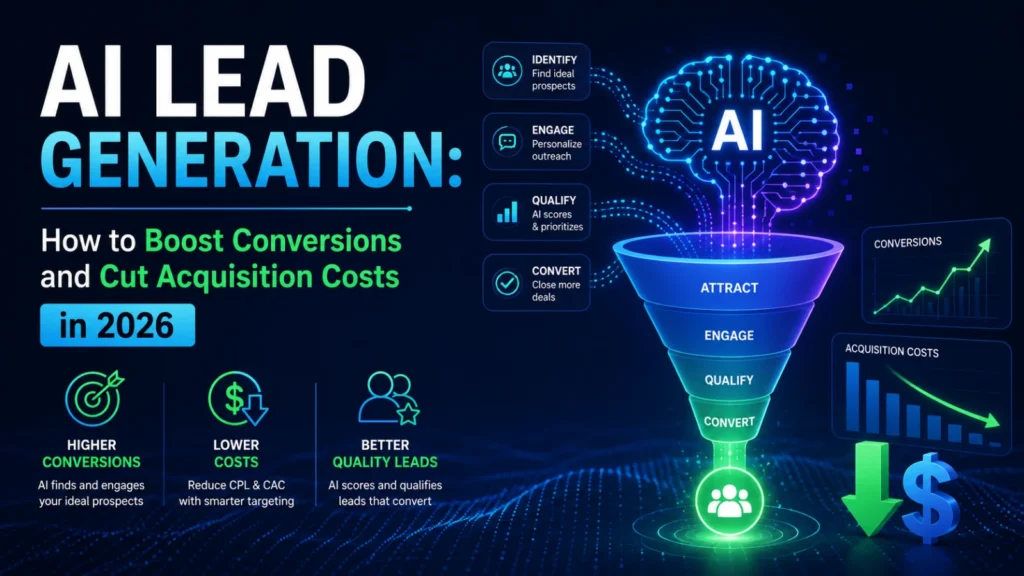
AI has moved well past being a buzzword in sales and marketing — it’s genuinely changing how businesses find, qualify, and convert leads. Whether the goal is predicting which prospects are actually ready to buy or automating the repetitive parts of outreach, AI now touches nearly every stage of the lead generation funnel. And it keeps working around the clock, analyzing data and engaging prospects long after a sales team has logged off for the day.
Businesses that adopt AI-driven lead generation tend to see real gains — often both stronger conversion rates and lower acquisition costs, since AI handles the qualification and targeting work that used to consume significant manual effort. Here’s a practical look at how AI lead generation actually works and how to put it to use.
What AI Lead Generation Actually Is
AI lead generation uses technology — chatbots that interact with prospects in real time, and machine learning models that improve by learning from data — to identify and connect with potential customers faster and more precisely than manual processes typically allow. The goal is the same as always: find people who are genuinely likely to buy, understand what they need, and move them toward becoming actual customers. AI just does it with more data and less manual guesswork.
Why AI Genuinely Works Well for Lead Generation
A few concrete advantages show up consistently. Efficiency improves because AI automates the repetitive, time-consuming parts of the process, freeing sales teams to focus on higher-value conversations rather than manual list-building and outreach. Lead qualification gets sharper because AI can score and prioritize leads based on real behavioral data, which means the leads actually reaching a sales rep are more likely to convert. And personalization improves because AI can analyze individual behavior patterns and tailor messaging accordingly, rather than sending the same generic pitch to everyone.
How to Actually Put AI to Work in Lead Generatio
Automated outreach
AI-powered tools can run outreach around the clock — sending personalized emails at the times individual leads are statistically most likely to open and engage with them, which meaningfully improves open and response rates compared to a single blanket send time. Conversational AI tools can handle scheduling demos, offering relevant product suggestions, and flagging genuinely promising leads for a human rep to follow up with directly.
This kind of automation also extends to identifying and engaging prospects on social platforms, and to sending contextually relevant follow-up messages based on how a lead has actually interacted with prior outreach — all of which adds up to more consistent engagement and fewer leads that quietly fall through the cracks.
Predictive analytics
Traditional targeting often leans on broad demographic categories — age, location, job title. AI goes considerably deeper, analyzing actual behavior: how someone interacts with a brand, what content they engage with, how often they return. That behavioral signal is generally a much stronger predictor of purchase intent than demographic data alone.
By pulling in data from website activity, social engagement, and email interaction, AI can identify patterns — like optimal times to reach out, or the type of content a given lead responds to — and use those patterns to score leads by likelihood to convert. High-scoring leads get prioritized for immediate follow-up, while lower-scoring ones get nurtured with more targeted, lower-pressure content until they’re further along. AI can even estimate roughly when a lead is likely to be ready to make a decision, which helps sales teams time outreach more precisely rather than guessing
Data enrichment
AI-driven enrichment tools automatically pull in additional context about a lead — company details, role, social presence, prior interactions — turning a bare email address into a much richer profile. That extra context lets sales and marketing teams craft messaging that actually speaks to a specific prospect’s situation rather than sending generic, one-size-fits-all outreach.
For example, a lead captured through a simple website form can be automatically enriched with organizational background and an estimated conversion likelihood almost immediately, giving a sales rep real context before the very first conversation.
Lead scoring
AI-driven lead scoring, often built directly into CRM platforms, ranks leads by how likely they are to convert. It works by pulling signals from multiple touchpoints — website visits, email engagement, social interaction, CRM activity — and identifying which patterns have historically correlated with actual conversions.
Based on those patterns, each lead gets scored using a combination of firmographic and behavioral signals — email opens, form completions, click behavior, overall engagement depth. This lets sales teams focus follow-up energy on the leads statistically most likely to convert, rather than working through a list in the order it happened to arrive.
Sharper targeting
AI can analyze customer data to improve both ad targeting and content personalization well beyond basic demographic segmentation. Rather than targeting by age or location alone, AI looks at actual behavior — search history, past purchases, social activity, expressed preferences — to predict who’s genuinely likely to be interested in a given offer.
That deeper behavioral picture lets a business build detailed customer profiles and tailor ads and content to match specific interests, which increases the odds that the right message reaches the right person at the right moment — a meaningfully better outcome than broad, generic targeting.
Categories of Tools Worth Knowing
Several categories of tools now support AI-driven lead generation, each suited to slightly different needs.
Sales-focused prospecting tools use AI to identify high-intent leads and help craft personalized outreach at scale — particularly useful for B2B sales teams in technology, SaaS, or consulting who want to reduce time spent on manual prospecting.
Professional network prospecting platforms (like LinkedIn’s sales-focused tools) help sales teams search a large professional network directly, surfacing relevant leads and providing insight into buying signals and engagement likelihood — a strong fit for B2B teams that rely heavily on professional networking for pipeline.
CRM platforms with built-in AI scoring combine pipeline management with automated lead prioritization and reporting, which works well for small to mid-sized B2B companies that want AI-driven insight without a steep learning curve.
Data enrichment platforms specialize in providing detailed company and contact information to sharpen targeting and lead scoring, generally suited to mid-market and enterprise businesses managing larger, more complex pipelines.
Conversational marketing platforms engage website visitors in real time through AI-powered chat, qualifying and routing leads instantly and scheduling meetings automatically — typically a better fit for mid-market to enterprise companies investing seriously in conversational, real-time engagement.
The right tool ultimately depends less on which one has the flashiest feature list and more on which one your team will actually use consistently. Before choosing, it’s worth getting clear on team size, typical customer profile, and how complex your sales process actually is — a tool that fits naturally into existing workflows will get adopted; one that adds friction generally won’t.
The Bottom Line
AI has fundamentally changed what’s possible in lead generation — not by replacing sales and marketing judgment, but by handling the data-heavy work of identifying, scoring, and nurturing leads at a scale manual processes simply can’t match. Businesses that build a genuine AI-driven lead generation process — automated outreach, predictive scoring, enriched data, and sharper targeting working together — tend to see real improvements in both conversion rates and cost efficiency. The technology keeps improving too, meaning the businesses that start building this capability now are likely to keep compounding that advantage as the tools get even more capable
Frequently Asked Questions
What is AI lead generation?
AI lead generation uses artificial intelligence to identify, attract, qualify, and nurture potential customers. It leverages machine learning, predictive analytics, automation, and customer data to improve lead quality and increase conversion rates.
How does AI improve lead generation?
AI analyzes customer behavior, predicts buying intent, scores leads based on their likelihood to convert, automates repetitive tasks, personalizes communication, and helps sales teams focus on high-value prospects.
Can AI reduce customer acquisition costs?
Yes. AI reduces acquisition costs by targeting the right audience, minimizing wasted ad spend, improving lead qualification, automating follow-ups, and increasing conversion rates, resulting in a better return on investment (ROI).
What industries benefit most from AI lead generation?
AI lead generation is valuable across many industries, including:
- Real Estate
- Healthcare
- E-commerce
- SaaS
- Financial Services
- Education
- Manufacturing
- Hospitality
- B2B Services
- Digital Marketing
Is AI lead generation suitable for small businesses?
Absolutely. Many affordable AI-powered tools help small businesses automate lead capture, customer engagement, email marketing, and sales follow-ups, allowing them to compete more effectively without large marketing teams.
How does AI qualify leads?
AI evaluates multiple factors such as website activity, demographics, engagement history, purchasing behavior, email interactions, and CRM data to assign a lead score, helping businesses prioritize prospects most likely to convert.
What are the best AI tools for lead generation?
Popular AI-powered lead generation tools include ChatGPT, HubSpot AI, Salesforce Einstein, Zoho CRM AI, Apollo.io, Drift, Intercom, Jasper AI, and various AI chatbots that automate customer interactions and lead qualification.
Can AI personalize customer communication?
Yes. AI can personalize emails, chatbot conversations, product recommendations, landing pages, and marketing campaigns based on customer preferences, browsing behavior, and purchase history, improving engagement and conversions.
Does AI replace human sales teams?
No. AI is designed to support sales and marketing teams, not replace them. It automates repetitive tasks, provides valuable insights, and helps identify high-quality leads, while human sales professionals build relationships, negotiate, and close deals.
What are the biggest benefits of AI lead generation?
The key benefits include:
- Higher-quality leads
- Faster lead qualification
- Improved conversion rates
- Lower customer acquisition costs
- Better customer insights
- Automated follow-ups
- Increased sales productivity
- Enhanced marketing ROI
How can businesses get started with AI lead generation?
Start by defining your target audience, selecting AI-powered CRM or marketing tools, integrating them with your website, automating lead capture and nurturing workflows, and continuously monitoring performance to optimize your campaigns.
What is the future of AI lead generation?
The future of AI lead generation lies in predictive analytics, conversational AI, hyper-personalization, voice search optimization, autonomous marketing automation, and real-time customer engagement. As AI technology continues to evolve, businesses that adopt AI-driven strategies will be better positioned to generate high-quality leads, reduce acquisition costs, and achieve sustainable growth.
