
A campaign can have great creative, solid budgets, and a skilled team behind it. It can still underperform if the platform is learning from incomplete data. That’s not just a reporting issue; it’s a real performance problem. Server-side tracking exists to fix exactly this gap.
Why This Matters More as Campaigns Become AI-Managed
Smart Bidding, Performance Max, Demand Gen, and Meta Advantage+ all rely on conversion signals. These systems decide who to target and how much to bid automatically. If they’re trained on partial or inaccurate data, they don’t just report badly. They actively optimize in the wrong direction, at scale.
Why Browser-Based Tracking Became Unreliable
Conversion tracking used to be simple: a browser tag fired, and a platform recorded it. Privacy protections, consent requirements, ad blockers, and cross-device journeys changed that entirely. A lead can still convert while the platform never fully sees it happen. Google’s own Consent Mode and Enhanced Conversions exist because of this exact gap.
Why Businesses Often Misdiagnose the Real Problem
When cost per lead rises, teams often blame the creative or the audience. Sometimes that’s true, but it’s rarely the complete picture. Often, the campaign is still generating value the platform simply can’t see. Tracking quality deserves treatment as a performance variable, not a technical afterthought.
Why AI Makes Accurate Measurement More Important, Not Less
AI platforms don’t inherently know which leads are actually valuable to a business. They learn entirely from the conversion signals they’re given to work with. If weak leads and qualified leads get counted identically, volume gets optimized over value. If offline sales never reach the platform, it can’t learn what drives revenue.
The Feedback Loop Problem This Creates
Poor tracking doesn’t just distort a report after the fact. It actively shapes future optimization decisions inside the ad platform itself. A campaign with incomplete signals may get under-funded, despite performing well in reality. Teams then respond by changing budgets or blaming the channel entirely.
What Server-Side Tracking Actually Changes
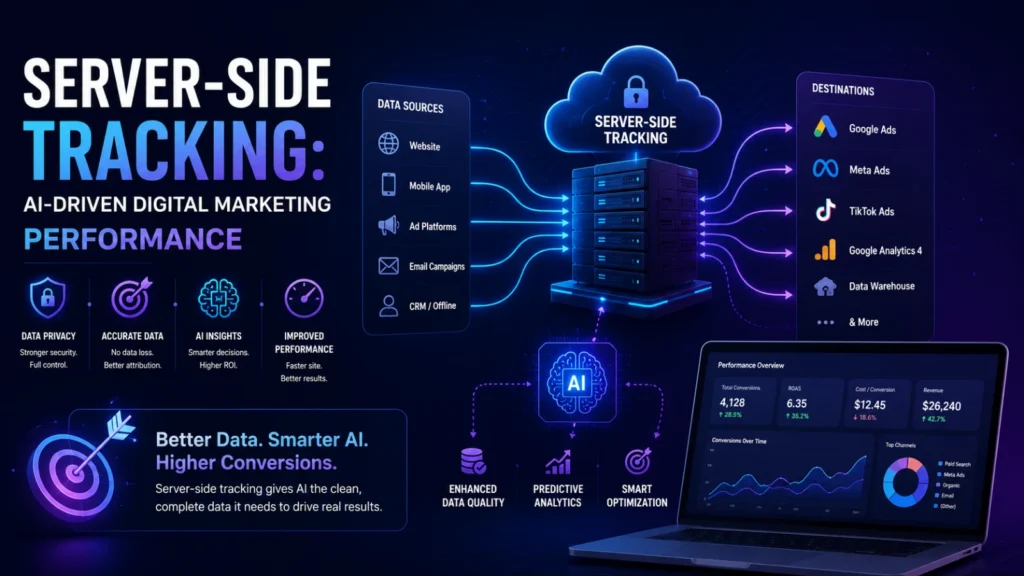
In a standard setup, tags fire directly from a visitor’s browser to ad platforms. In a server-side setup, that data first passes through a business-controlled server. From there, it gets forwarded to platforms like Google Ads, Meta, or LinkedIn. This gives businesses real control over data quality, privacy, and reliability.
It's Not a Magic Fix, and It Shouldn't Be Sold as One
Server-side tracking won’t recover every lost signal or bypass user consent choices. It must still be implemented responsibly, transparently, and within legal boundaries. What it does is create a controlled layer for processing and enriching data. That stronger foundation supports things like Enhanced Conversions and offline conversion imports.
The Real, Often Invisible Cost of Poor Tracking
Imagine a business spending significantly on lead generation each month. If a quarter of qualified leads never get tracked accurately, the platform sees less. With fewer real signals, it makes more conservative, less confident bidding decisions. Budget can quietly shift away from campaigns that were actually working well.
The Opposite Problem Is Just as Damaging
Some businesses count every form submission as an equal, identical conversion. The platform then optimizes toward cheap leads, not genuinely qualified ones. The dashboard can look healthy while the sales team grows increasingly frustrated. This is exactly why CRM integration matters as much as tracking itself.
Connecting Server-Side Tracking to Real Business Outcomes
A submitted form is useful, but a qualified lead means much more. A booked consultation matters more still; a closed deal matters most. Connecting server-side data with CRM and offline conversion imports closes this gap. That connection is what lets AI optimize toward outcomes that genuinely matter.
Building the Measurement Stack, Step by Step
Start with an honest audit of current conversions, tags, and consent setup. Identify duplicate events and unclear handovers between marketing and CRM systems. Configure consent handling correctly wherever regulations require it for your market. Enable enhanced, privacy-safe matching using available first-party customer data.
From there, introduce a server-side container for your highest-priority conversion events. Import offline conversion data so platforms can learn what actually drives revenue. Finally, monitor diagnostics regularly to catch measurement gaps before they distort results.
Why This Becomes a Real Competitive Advantage
The next stage of digital marketing won’t be decided by tool adoption alone. It will be shaped by who feeds those tools the best data. As third-party cookies fade and privacy expectations rise, first-party strategy matters more. Businesses building this now avoid reactive scrambling once tracking fully breaks.
The Bottom Line
Server-side tracking isn’t a trend; it protects the data marketing decisions depend on. When that data improves, bidding improves, budgets get allocated more wisely, and confidence grows. Businesses treating this as core infrastructure, not an afterthought, build real marketing intelligence. In an AI-driven advertising world, that intelligence becomes a lasting advantage.
Frequently Asked Questions
Is server-side tracking only relevant for large advertising budgets?
No. Any business running paid campaigns benefits from more accurate conversion data. Budget size affects urgency, not whether the problem exists.
Does server-side tracking replace the need for user consent?
No. It must still operate within consent requirements and privacy regulations. It improves data handling, not the legal basis for collecting it.
How does this connect to Smart Bidding specifically?
Smart Bidding optimizes based entirely on the conversion signals it receives. Better, more complete signals lead to noticeably better bidding decisions.
Why does counting every form submission as a conversion cause problems?
It teaches the platform to optimize for volume, not lead quality. This can produce more leads while actual sales results stay flat.
What role does CRM integration actually play here?
It connects marketing activity to real outcomes, like qualified leads and closed deals. Without it, platforms only see surface-level actions, not results.
Where should a business realistically start with this?
Start with an honest audit of current tracking, consent, and conversion setup. That audit reveals where the biggest, most urgent gaps actually are.
