
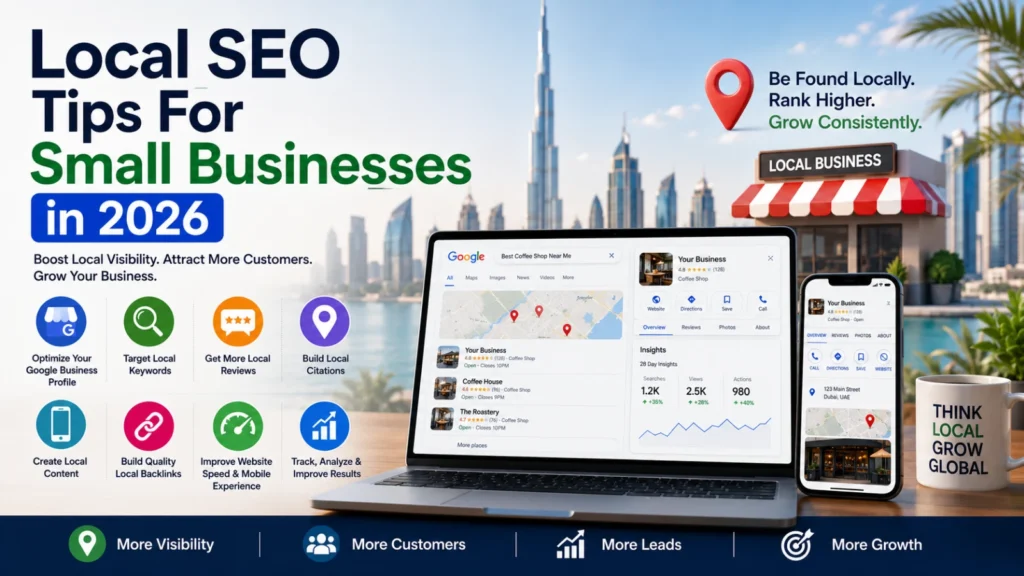
Local SEO in 2026 is really about one thing: showing up when someone nearby searches for exactly what you sell. When a customer types “coffee shop near me” or “plumber near me,” local SEO is what determines whether your business shows up at the top of that list or gets buried behind three competitors. Done well, it builds credibility through reviews, improves your position in map results, and brings genuinely ready-to-buy customers straight to your door — without needing to outspend larger competitors on ads.
Here’s a practical breakdown of what actually moves the needle for small businesses this year.
What Local SEO Actually Means for a Small Business
At its core, local SEO is the set of practices that make your business visible in search results to people searching nearby — optimizing your online presence so search engines connect your business to local, geographically relevant queries. It’s less about ranking for broad, competitive national terms and more about owning your specific neighborhood or service area online.
Why It Matters More Than Ever
The effort-to-reward ratio is genuinely favorable. Local SEO doesn’t require a huge budget or a dedicated team to get started — setting up and properly filling out a Google Business Profile alone puts you ahead of a surprising number of local competitors who haven’t bothered. Responding to reviews and keeping your profile updated becomes routine fairly quickly once it’s part of your workflow.
Local search behavior keeps growing. A meaningful share of consumers now research a business online before ever visiting in person, and that share keeps climbing. Both brick-and-mortar and online businesses are adapting to this shift — the question isn’t whether to invest in local SEO, it’s whether you do it before or after your competitors do.
It’s not a passing trend — it’s infrastructure. Search behavior evolves constantly, but the underlying need for local discoverability isn’t going anywhere. Betting against local SEO and hoping competitors don’t bother investing in it either is a genuinely risky strategy in a market where being discoverable increasingly is the business.
A Practical Setup Guide
Start with your Google Business Profile. This is the foundational step — create the profile, and fill it out as completely as possible from the start. You don’t need to be perfect on day one, but every day without a claimed profile is potential visibility left on the table.
Get verified. Verification protects your listing from impersonation and gives your profile more credibility with both Google and customers. It’s usually a quick process, completable from a computer or directly through a smartphone.
Keep contact information complete and accurate. Business hours, address, phone number — all of it needs to be correct and current. Add holiday hours, a clear description, and quality photos where possible. The more complete and accurate your profile, the better it tends to perform, and errors here get penalized rather than ignored.
Sweat the small details. Something as minor as incorrect operating hours can send customers to a competitor and hurt your credibility. Set a reminder to review your profile regularly — forgetting to update holiday hours is a small mistake with an outsized impact on customer trust.
Treat the profile as an ongoing project, not a one-time task. Upload fresh photos periodically, respond to new reviews as they come in, and keep information current. Profiles that stay active tend to rank better and get noticed more than ones that are set up once and never touched again.
Ten Practical Tips
1. Maintain it consistently, not just at setup. Your business profile is a living asset — reviews come in, hours change seasonally, and all of it needs regular attention rather than a one-time setup.
2. Don’t rely on Google alone. While Google dominates search volume, maintaining a presence on other search engines and directories with the same level of accuracy and completeness broadens your visibility without much extra effort.
3. Get your NAP details exactly right. Name, Address, and Phone number consistency across every platform matters enormously — a wrong address sends a real customer to the wrong location, and that’s a lost sale you likely won’t get back.
4. Design for mobile first. More people search on their phones than on desktop now, and that gap keeps widening. Keep descriptions concise and images sized appropriately — a wall of text or an oversized photo doesn’t render well on a small screen.
5. Actively manage your reviews. Responding to reviews — positive and negative — signals genuine engagement to both search engines and prospective customers. Silence on a negative review looks worse than a thoughtful response does.
6. Optimize the site behind the profile. Your website needs solid technical fundamentals too — clean site structure, proper meta descriptions and title tags, and genuine mobile usability. A business profile can only do so much if the website it links to is poorly built or slow to load.
7. Target genuinely local keywords. The strongest local keywords combine what you sell with where you’re located — “digital marketing agency in Dubai” rather than just “digital marketing agency.” Work these naturally into your content rather than stuffing them in unnaturally, which search engines penalize.
8. Build quality backlinks. Links from other credible local or industry sites signal trust to search engines. Quality matters far more than volume here — a handful of genuinely relevant, credible backlinks outperform dozens of low-quality ones.
9. Give it time before judging results. Search engines take time to crawl, index, and reflect changes — don’t panic if a profile update or new content doesn’t move rankings within days. Give it a solid month or more before reassessing your approach.
10. Don’t rely on local SEO alone. It’s a powerful channel, but pairing it with offline efforts — local sponsorships, community events, in-person promotions — and a consistent social media presence reinforces everything else you’re doing online.
Bottom line
SEO, local or otherwise, rewards patience and consistency far more than it rewards any single clever tactic. Results tend to build incrementally rather than arrive all at once, which means the businesses that stick with steady, unglamorous upkeep — accurate information, regular reviews, fresh content — tend to outperform ones chasing quick fixes.
If time or bandwidth is the real constraint, bringing in a local SEO specialist to handle the ongoing maintenance is often a better use of resources than letting the whole effort quietly stall out from neglect. Either way, the businesses that treat local visibility as an ongoing discipline rather than a one-time setup task are the ones that actually show up when it counts.
Frequently Asked Questions
What is Local SEO?
Local SEO is the process of optimizing your online presence to help your business appear in local search results on Google and other search engines. It focuses on attracting nearby customers searching for products or services in a specific geographic area.
Why is Local SEO important for small businesses?
Local SEO helps small businesses increase visibility, attract nearby customers, generate more phone calls, drive foot traffic, and compete with larger brands in local search results.
How can I improve my Google Business Profile ranking?
To improve your Google Business Profile ranking:
- Complete your business profile with accurate information.
- Add high-quality photos.
- Choose the correct business categories.
- Encourage customer reviews.
- Post regular updates.
- Keep your business hours and contact details up to date.
How long does Local SEO take to show results?
Local SEO is a long-term strategy. Most businesses begin seeing noticeable improvements within 3 to 6 months, depending on competition, website quality, and optimization efforts.
What are local keywords?
Local keywords are search terms that include a location, such as “web design company in Dubai,” “best restaurant in Abu Dhabi,” or “SEO services near me.” These keywords help search engines understand the geographic relevance of your business.
Are online reviews important for Local SEO?
Yes. Positive customer reviews improve your business’s credibility and can positively influence local search rankings. Responding to reviews also demonstrates that you value customer feedback and engagement.
What are local citations?
Local citations are online mentions of your business’s Name, Address, and Phone Number (NAP) on directories, business listings, and review websites. Consistent citations help search engines verify your business information and improve local rankings.
Does mobile optimization affect Local SEO?
Absolutely. Most local searches are performed on mobile devices. A fast, mobile-friendly website provides a better user experience and is an important ranking factor for local search results.
How often should I update my Google Business Profile?
Update your profile whenever your business information changes. You should also regularly publish posts, upload new photos, respond to reviews, and answer customer questions to keep your profile active and engaging.
Can Local SEO help my business get more customers?
Yes. Local SEO helps your business appear when nearby customers search for your products or services. Increased visibility in local search results can lead to more website visits, phone calls, direction requests, inquiries, and ultimately, more sales.
What is the biggest Local SEO mistake small businesses make?
One of the most common mistakes is having inconsistent business information across different websites. Other mistakes include neglecting Google Business Profile optimization, ignoring customer reviews, targeting the wrong keywords, and failing to optimize for mobile users.
Is Local SEO better than paid advertising?
Local SEO and paid advertising serve different purposes. Local SEO delivers sustainable, long-term organic visibility, while paid advertising provides immediate traffic and leads. For the best results, many small businesses combine both strategies to maximize their online presence.
