
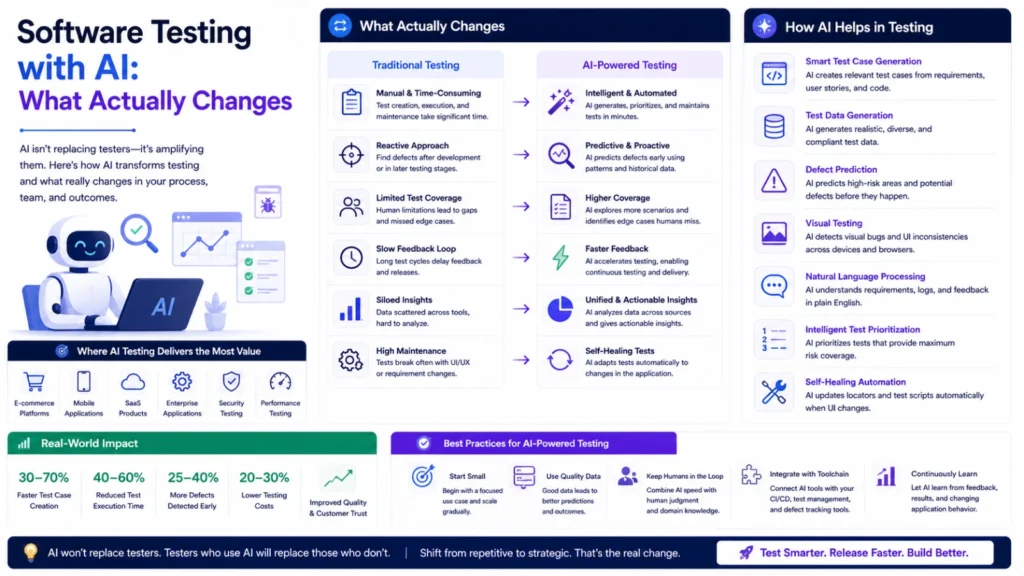
Testing has always been necessary but rarely anyone’s favorite task. Writing test cases, chasing edge cases, and fixing flaky scripts takes real time. AI tools are now reshaping large parts of that process. Here’s what’s genuinely changing and what still needs a human.
Generating Test Cases Faster
AI tools can read code or requirements and suggest test cases. Claude, ChatGPT, and Katalon Studio all support this kind of generation. They often catch edge cases a rushed developer might skip. This doesn’t replace thoughtful test design entirely though. It gives testers a stronger starting point instead of a blank page. Reviewing and refining those suggestions still matters afterward.
Writing and Maintaining Test Scripts
Writing automated test scripts by hand is slow, repetitive work. AI assistants like Claude, ChatGPT, and GitHub Copilot can draft scripts quickly. Testim and Mabl specialize in self-healing scripts for web apps. They automatically update scripts when an application’s interface changes slightly. This maintenance work used to consume significant tester time each sprint. Reducing it frees testers for more meaningful analysis work.
Spotting Flaky and Unreliable Tests
Flaky tests pass and fail inconsistently without any real code change. Tools like Launchable and ReportPortal analyze test history to flag likely flaky tests. This saves time normally spent manually re-running and investigating failures. Fixing the root cause still requires genuine human debugging though. AI mainly helps surface which tests deserve that attention first.
Visual and UI Testing
Comparing screenshots across builds used to require tedious manual review. Tools like Applitools and Percy now detect unexpected layout changes automatically. They can flag a shifted button or a broken image instantly. This catches visual regressions that functional tests often miss entirely. Human review still confirms whether a flagged change is actually a bug.
Exploratory and Edge-Case Testing
AI tools like Mabl and Functionize can simulate unusual user behavior quickly. This includes unexpected input combinations or unusual navigation paths. It helps surface bugs that scripted, predictable tests tend to miss. This doesn’t replace genuine exploratory testing by an experienced human tester. It does make that exploration faster and better informed.
Analyzing Test Results and Bug Reports
After a large test run, sorting through failures takes real time. Claude and ChatGPT can summarize failures and group similar issues together. This helps teams prioritize which bugs matter most, faster. It also helps write clearer, more useful bug reports for developers. Less time gets spent on manual triage as a result.
What AI Still Can’t Replace in Testing
AI tools don’t understand real user needs the way a person does. They can’t judge whether a feature actually solves the intended problem. Genuine risk-based prioritization still requires human judgment and context. Critical, high-stakes testing still needs careful human review before release. AI works best as a capable assistant, not a replacement tester.
The Bottom Line
AI is genuinely speeding up test case generation, scripting, and analysis. It’s also improving flaky test detection and visual regression checks. None of this removes the need for skilled human testers though. Judgment, prioritization, and understanding real user needs still require people. Used well, AI frees testers to focus on the work that matters most.
Frequently Asked Questions
Can AI completely replace manual software testing?
No. AI speeds up repetitive tasks like scripting and analysis. Judgment-heavy testing still needs an experienced human tester.
Is AI-generated test coverage reliable enough to trust fully?
Not entirely on its own. AI-generated tests need human review before being trusted completely. They’re a strong starting point, not a final answer.
How does AI help with flaky tests specifically?
AI analyzes test history to flag tests that fail inconsistently. This helps teams prioritize which flaky tests to investigate first.
Can AI tools catch visual bugs a functional test would miss?
Yes. AI-powered visual testing tools compare screenshots across builds automatically. They flag unexpected layout or design changes quickly.
Does using AI in testing reduce the need for QA teams?
It changes the work more than it reduces the team. QA roles shift toward judgment, review, and prioritization instead.
What’s the biggest risk of relying too heavily on AI for testing?
Missing context-specific bugs that require real user understanding. AI lacks judgment about whether a feature truly serves users well.
