
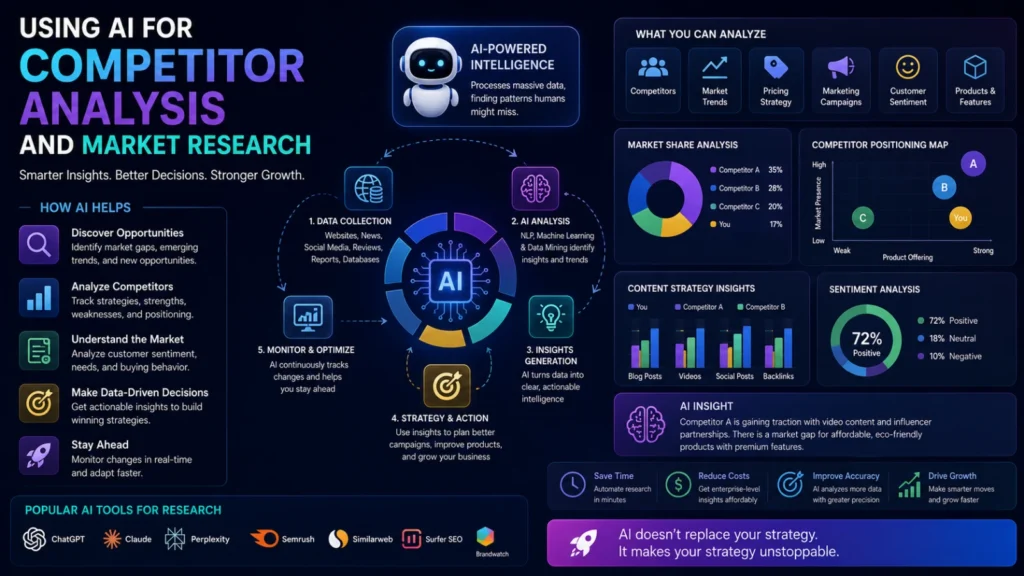
Competitor analysis once required teams to manually visit competitor websites, capture pricing pages, review customer feedback, and compile everything into presentations that often became outdated within weeks. Many businesses still rely on this time-consuming process, but AI now automates much of this repetitive, data-intensive work, making competitor research faster and more efficient.
While AI hasn’t replaced strategic decision-making in market research, it has transformed how quickly and thoroughly businesses gather and analyze competitive data. Human expertise remains essential for interpreting insights and making informed business decisions. This article explores where AI adds real value to competitor analysis and market research, as well as the areas where human judgment continues to play a critical role.
What’s Actually Changed
Traditional competitor analysis limited teams by the amount of information they could realistically read, compare, and analyze within a reasonable timeframe. AI removes much of this limitation by processing large volumes of website content, customer reviews, pricing pages, and public data in minutes. It quickly identifies trends, patterns, and insights that would otherwise require hours of manual research and cross-referencing across multiple sources.
However, AI can only analyze the data it receives or can access publicly. It cannot uncover a competitor’s internal strategy, confidential information, or proprietary business data. Its true strength lies in processing publicly available information faster and more comprehensively, enabling businesses to make better-informed decisions based on reliable market signals.
Where AI Genuinely Helps
Synthesizing Competitor Content at Scale
Reading through a competitor’s entire website, blog, and marketing materials to understand their positioning and messaging used to take hours per competitor. AI can process that volume of content quickly and summarize the actual value proposition, target audience signals, and messaging themes a competitor is emphasizing — turning a multi-hour reading exercise into a much faster synthesis step, with a person still reviewing and validating the output.
Sentiment and Review Analysis
Customer reviews across platforms — Google, Trustpilot, app stores, industry-specific review sites — contain a genuine goldmine of information about what a competitor’s customers actually like and complain about. Manually reading through hundreds or thousands of reviews isn’t realistic for most teams. AI can process that volume and surface recurring themes: which features customers praise, what complaints show up repeatedly, where a competitor’s service consistently falls short. That kind of pattern extraction is one of the clearest wins in this space, since it turns scattered, unstructured text into an actual list of strengths and weaknesses.
Tracking Pricing and Positioning Changes
Competitors adjust pricing, packaging, and messaging more often than most companies actively monitor. AI-assisted monitoring can flag when a competitor’s public pricing page changes, when new features get announced, or when messaging shifts — turning what used to be occasional manual spot-checks into something closer to continuous tracking.
Identifying Market Trends and Gaps
Beyond individual competitors, AI can help process broader market signals — industry news, social media discussion, search trend data — to surface emerging themes a market is moving toward, or gaps where customer needs aren’t being well served by existing players. This kind of pattern recognition across a large, unstructured dataset is exactly the type of task AI handles more efficiently than manual research.
Drafting the First Version of Comparison Content
Once the underlying research is gathered, AI can help draft a first-pass competitive comparison document, battlecard, or positioning summary — giving a team a structured starting point to refine rather than building the document from a blank page. This still needs human review for accuracy and nuance, but it meaningfully speeds up the “get something on paper” step.
Summarizing Earnings Calls, Reports, and Public Filings
For competitors that are public companies or publish detailed reports, AI can quickly summarize lengthy earnings calls, annual reports, or press releases, extracting the strategic signals (stated priorities, new market entries, leadership commentary) without requiring someone to read the entire document.
Where AI Still Falls Short
It can’t access private or gated information. AI can only analyze publicly available data or information you explicitly provide. It cannot retrieve content behind login portals, private sales conversations, or unpublished internal documents. Businesses must still rely on primary research methods, such as customer interviews, sales insights, and direct competitive intelligence, to gather confidential market information.
It can misinterpret context or nuance. AI excels at identifying patterns in customer reviews and summarizing large datasets, but it may overlook sarcasm, industry-specific terminology, or the difference between isolated complaints and recurring issues. Always verify AI-generated insights against the original source material before making business decisions.
It doesn’t understand strategic intent. AI can identify changes in a competitor’s pricing, messaging, or product offerings, but it cannot reliably explain the reasoning behind those decisions. Understanding strategic intent still requires human expertise, industry knowledge, and business context.
Data can be stale or incomplete. AI relies on the information available at the time of analysis. In rapidly changing markets, competitor pricing, products, and positioning can change quickly. Regularly review and validate the underlying data to ensure your competitive insights remain accurate and relevant.
Accuracy needs verification. Like any AI-generated content, competitor analysis may occasionally contain inaccuracies, incorrect attributions, or unsupported conclusions. Treat AI as a research assistant that delivers a strong first draft, then verify every critical finding before using it to guide business strategy or decision-making.
A Practical Workflow
To combine AI effectively with human expertise, start by asking specific research questions instead of broad requests like “analyze my competitors.” Questions such as “What are the most common customer complaints in a competitor’s reviews?” or “How has a competitor’s pricing changed over the past year?” generate more accurate and actionable insights.
Whenever possible, provide AI with reliable source material, including customer reviews, competitor website content, pricing pages, and press releases, instead of relying solely on its existing knowledge. Let AI handle repetitive tasks such as reading large volumes of content, summarizing information, and identifying patterns across multiple sources.
Once AI delivers the findings, apply human expertise to interpret the results, identify meaningful business opportunities, and uncover context that AI may overlook. Finally, make competitor analysis an ongoing process rather than a one-time project. Since competitors continuously update their pricing, messaging, and market positioning, regular analysis helps you stay informed and maintain a competitive advantage.
The Bottom Line
AI has transformed the research-intensive aspects of competitor analysis and market research. It can analyze large volumes of customer reviews, monitor competitor updates, and generate initial research summaries in minutes instead of days. This allows businesses to gather competitive insights faster and more efficiently.
However, AI cannot replace the strategic thinking required to turn research into informed business decisions. It also cannot access private or confidential information that is unavailable to the public or not explicitly provided.
When used effectively, AI serves as a powerful research assistant rather than a replacement for human expertise. By automating data collection, analysis, and summarization, it frees teams to focus on interpreting insights, refining strategies, and making confident, data-driven decisions that create a competitive advantage.
Frequently Asked Questions
Can AI replace a market research team entirely?
No. AI excels at processing large volumes of research data, such as analyzing customer reviews, summarizing content, and tracking competitor changes. However, it cannot access private information, understand business strategy, or make the critical decisions that require human expertise. Businesses should use AI to accelerate and enhance the research process while relying on experienced professionals to interpret insights and make strategic decisions.
How accurate is AI-generated competitor analysis?
The accuracy of AI-generated competitor analysis depends on the quality and freshness of the source data. AI can occasionally exaggerate patterns, overlook context such as sarcasm in customer reviews, or analyze outdated information if it cannot access the latest data. Always verify important findings against the original sources before using them to make business decisions or treating them as factual.
What kind of data can AI actually analyze for competitor research?
AI can analyze any information that is publicly available or that you explicitly provide, including competitor websites, blog content, customer reviews, press releases, public financial filings, earnings call transcripts, social media discussions, and exported datasets such as review CSV files. However, AI cannot access content behind login portals, private sales conversations, confidential documents, or unpublished internal competitor data.
Is AI-based competitor monitoring a one-time project or ongoing?
It works best as an ongoing practice rather than a single research sprint. Competitor pricing, messaging, and positioning shift continuously, and a report built once goes stale within a few months. Setting up a recurring cadence — even a simple periodic check — keeps the findings actually useful.
What’s the biggest mistake teams make when using AI for this?
Asking vague, open-ended questions like “analyze my competitors” and treating the output as a finished conclusion. Specific questions — about pricing changes, recurring review complaints, or messaging shifts — produce far more useful results, and the output should still be reviewed by someone with business context before it drives a decision.
Do I need special tools, or can I just use a general AI assistant?
A general AI assistant can handle a surprising amount of this — summarizing content you provide, analyzing exported reviews, drafting comparison documents. Dedicated competitive intelligence tools add value mainly through automated, continuous monitoring (tracking changes without you having to manually re-check), which becomes more worthwhile as the number of competitors being tracked grows.
