
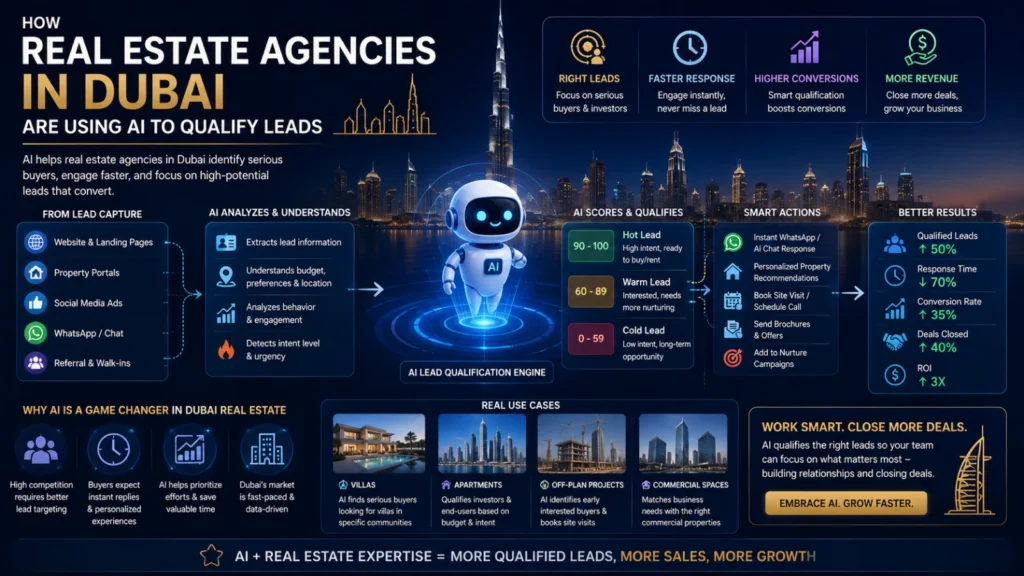
Dubai’s property market moves quickly and generates a huge volume of inquiries from portals, WhatsApp, social media, launches, and websites. Many agencies struggle not with lead volume, but with unqualified prospects, duplicates, and time-consuming manual screening.
AI-driven lead qualification helps solve this challenge by handling initial engagement and sorting leads before they reach agents. It supports sales teams without replacing the human touch.
Why Lead Qualification Is a Particular Challenge in Dubai’s Market
A few dynamics specific to this market make qualification genuinely harder than in a lot of other real estate environments. Dubai’s property market attracts international buyers across different languages, time zones, and communication preferences. Off-plan launches often create large inquiry spikes, including many early-stage investors researching options. Buyer intent varies widely, from urgent relocations to long-term market exploration, making generic follow-up sequences ineffective for many leads.
How AI Is Actually Being Used to Qualify Leads
Instant, Round-the-Clock First Response
A lead who inquires at 11pm and receives a reply the next afternoon may have already contacted multiple agencies. WhatsApp-based AI assistants quickly engage leads and gather essential details, helping agents focus on qualified prospects.
Scoring Leads Based on Real Signals
AI scoring models analyze budget, engagement, response speed, and financing details to identify leads most likely to convert. Agents end up working a prioritized list instead of a raw, unsorted inbox.
Enriching Leads Automatically
A bare inquiry — a name, phone number, and a listing reference — doesn’t tell an agent much. AI-driven tools enrich lead profiles with relevant data, enabling agents to have more informed conversations from the first interaction.
Multilingual Conversation Handling
Given how international Dubai’s buyer base is, AI chat tools that can hold a qualifying conversation in Arabic, English, Russian, Mandarin, or Hindi — matching whichever language a lead engages in — remove a real bottleneck that used to require routing inquiries to specific bilingual staff before qualification could even begin.
Filtering Out Low-Intent and Duplicate Inquiries
Off-plan launches in particular tend to generate a flood of speculative inquiries, some from the same person submitting through multiple channels. AI systems can flag likely duplicates and deprioritize clearly low-intent submissions (generic form spam, obviously mismatched budget-to-property ratios) so agents aren’t wasting calls on leads that were never going to convert.
Predicting Purchase Timeline
Beyond a simple qualified/unqualified split, some AI-driven smart property CRM tools now estimate when a given lead is likely to be ready to transact, based on patterns in their engagement so far. That lets an agency nurture longer-timeline investors with lighter-touch content while directing immediate attention toward leads showing signals of being ready now.
Automated, Personalized Follow-Up Sequences
Leads that aren’t ready today aren’t necessarily dead leads — Dubai’s investor-heavy buyer pool often takes months to move from initial interest to purchase. AI-driven nurture sequences keep those contacts warm with relevant, personalized content (new listings matching their stated preferences, market updates for their area of interest) without requiring an agent to manually track and follow up with every long-timeline lead individually.
What This Actually Changes for Agents
The practical effect of all this isn’t that agents talk to fewer people — it’s that the people they do talk to have already been pre-qualified on the basics, which makes every call more efficient and less speculative. Agents spend less time on unqualified budget conversations and repetitive first-contact questions, and more time on the parts of the job that actually require a human: building trust, negotiating, and closing.
What AI Still Can’t Do in This Process
Qualification tools are good at sorting based on stated and behavioral signals, but they can’t replace the judgment an experienced agent brings to reading a genuinely serious buyer versus someone who says all the right things but isn’t actually ready. Cultural nuance in negotiation, understanding a client’s real underlying motivation (an investment purely for yield versus a family relocating permanently), and building the kind of trust that closes a multi-million-dirham transaction still depend entirely on the human relationship. AI narrows down who’s worth that time — it doesn’t replace the work of earning it.
The Bottom Line
AI-driven lead qualification has become a practical necessity for Dubai real estate agencies dealing with high inquiry volume, an international buyer base, and the sharp spikes in interest that off-plan launches routinely generate. Used well, it handles the repetitive sorting and initial engagement work — instant response, scoring, enrichment, multilingual handling, nurture sequencing — freeing agents to spend their time where it actually matters: with buyers who are genuinely ready to move forward.
Frequently Asked Questions
Will AI lead qualification replace real estate agents in Dubai?
No. It handles the repetitive sorting and initial engagement work — responding instantly, asking basic qualifying questions, scoring leads — but the actual relationship-building, negotiation, and closing still depend on an agent. The goal is freeing up agent time for the leads and conversations that genuinely need a human, not removing agents from the process.
How does AI qualification work with WhatsApp, since that’s the main channel used in the UAE?
Many AI lead qualification tools integrate directly with WhatsApp Business, allowing an automated assistant to respond to inbound messages instantly, ask qualifying questions in the buyer’s language, and hand off a qualified conversation to a human agent once the basics are established — without the buyer needing to switch channels.
Can AI actually understand different languages and cultural context well enough for Dubai’s market?
Modern AI chat tools handle multiple languages reasonably well for straightforward qualifying conversations (budget, timeline, area preference). Cultural nuance in more complex conversations — negotiation style, reading unstated hesitation — is still something that benefits from a human agent, particularly once a lead moves past initial qualification.
Is AI lead scoring reliable, or does it miss good leads?
It’s reliable for surfacing the signals it’s been given — budget alignment, response behavior, stated timeline — but it isn’t infallible. A lead that scores low on stated criteria can still be a serious buyer who simply didn’t fill out every field, which is why most agencies treat AI scoring as a prioritization tool rather than an absolute filter, with agents still able to review lower-scored leads if something about them looks promising.
Does using AI for qualification reduce the total number of leads an agency has to handle?
Not exactly — inquiry volume generally stays the same or grows. What changes is how that volume gets processed: instead of an agent manually triaging every inquiry, AI handles the initial sorting and engagement, so the number of leads reaching a human at any given time becomes more manageable and better prioritized.
What’s the risk of relying too heavily on AI for lead qualification?
The main risk is over-filtering — treating an AI score as gospel and never following up with leads that scored lower, some of which may still be genuinely serious buyers who simply didn’t provide complete information upfront. It’s worth periodically spot-checking lower-scored leads and treating AI qualification as a prioritization aid rather than a strict
