
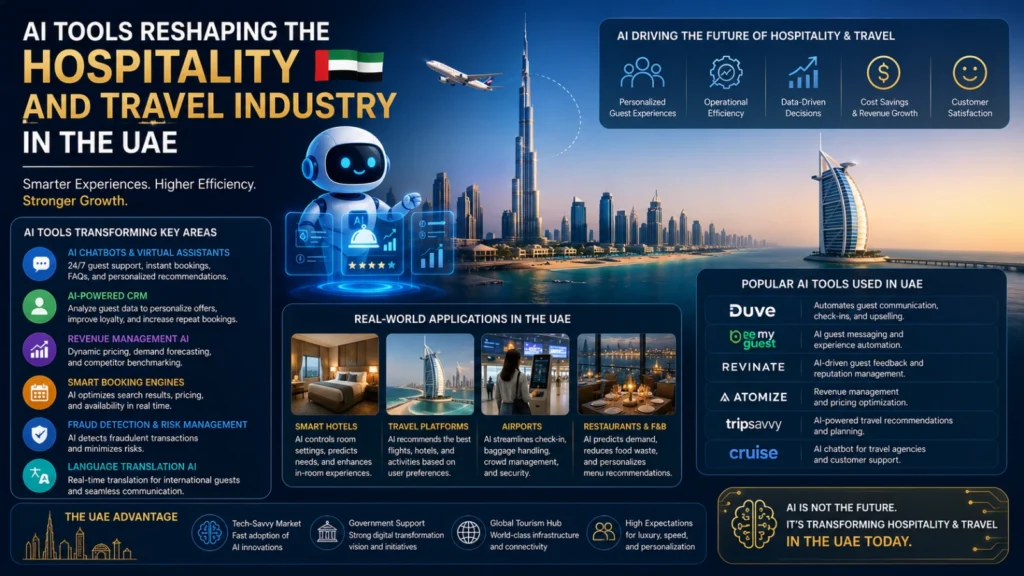
The UAE’s hospitality and travel sector moves at a demanding pace. Millions of international visitors pass through Dubai and Abu Dhabi each year. Guests arrive speaking dozens of languages with different cultural expectations. Hotels, airlines, and travel operators all compete intensely for the same traveler’s attention. AI has moved from a novelty here to a genuinely practical toolset. It’s already addressing these exact pressure points in guest-facing systems today.
Here’s where AI is actually changing hospitality and travel operations across the UAE. This isn’t a distant trend. It’s running in real systems right now.
Why the UAE Market Is a Natural Fit for AI Adoption
A few things about this market make AI adoption especially practical. The guest base is exceptionally international. That makes multilingual, always-available service genuinely valuable rather than a nice-to-have. Demand is also highly seasonal and event-driven. Major exhibitions, holidays, and peak tourism months create sharp demand spikes. Those spikes strain staffing models built around average demand. On top of that, the market is intensely competitive. Hotels, tour operators, and attractions all fight for the same traveler’s attention. Any tool that improves conversion or personalization has real value here.
Where AI Is Actually Being Used
Multilingual Guest Communication
AI chatbots and virtual concierges now handle a large share of routine guest questions. They’re often built into hotel apps, WhatsApp, and websites. They answer check-in questions, amenity details, and local recommendations. They do it in multiple languages at once. A single property might host guests speaking Arabic, English, Mandarin, Russian, and Hindi in one week. That used to require multilingual staff available around the clock. AI removes a real staffing bottleneck here.
Dynamic Pricing and Revenue Management
Hotels and airlines have used revenue management systems for years. AI has made these systems far more responsive. Pricing now adjusts in near real time based on demand signals. It also factors in competitor pricing, event calendars, and booking pace. That’s a shift from periodic manual review to constant adjustment. Demand in the UAE is heavily event-driven — major exhibitions, sports events, seasonal tourism spikes. That responsiveness has a real, measurable impact on revenue during peak periods.
Personalized Recommendations and Itinerary Building
AI personalization engines analyze a traveler’s past bookings and browsing behavior. They also factor in stated preferences. From that, they recommend activities, dining, and add-ons that actually fit. A generic “things to do” list becomes something tailored to one guest. Some travel platforms now auto-generate draft itineraries too. Travelers can adjust these drafts instead of building an itinerary from scratch.
Predictive Maintenance for Hotel and Airline Operations
Behind the scenes, AI-driven predictive maintenance is quietly changing operations. It monitors equipment like HVAC systems, elevators, and aircraft components. The goal is flagging likely failures before they actually happen. That’s a shift away from relying purely on scheduled maintenance cycles. For hotels, this reduces guest-facing disruption from unexpected equipment failures. For airlines, it meaningfully cuts costly unscheduled downtime.
Smart Room and Property Management
AI-integrated room systems can adjust lighting, temperature, and entertainment automatically. They do this based on a guest’s stored profile preferences. Property management systems increasingly use AI too. They forecast occupancy, optimize housekeeping schedules, and flag maintenance needs early. That reduces manual coordination work across large properties significantly.
Fraud Detection in Bookings and Payments
UAE travel platforms process a huge volume of international transactions. AI-driven fraud detection flags suspicious booking patterns in real time. It also catches payment anomalies as they happen. This matters for reducing chargebacks directly. It also protects a platform’s relationship with payment processors over time.
Sentiment Analysis Across Reviews and Social Media
Hospitality brands generate a constant stream of guest feedback. It comes through review platforms, social media, and post-stay surveys. AI sentiment analysis processes that volume quickly. It surfaces recurring themes — a staff behavior guests consistently praise, say. Or a maintenance issue showing up across multiple reviews. That’s far faster than any team reading reviews manually.
AI-Assisted Customer Service for Airlines and Travel Agents
UAE-based airlines and travel agencies use AI virtual assistants too. These handle routine booking changes, flight status checks, and baggage questions. That frees human agents for genuinely complex cases instead. Think a rebooking during a major disruption, or a sensitive service recovery. Those situations still need a real person involved.
Voice and Visual Search for Travel Planning
Some UAE travel platforms now support voice-based and image-based search. Travelers can describe what they want in plain language. “A beach resort with a kids’ club near Dubai Marina,” for example. Others search using a reference photo instead of menus. This shift in travel discovery is still early. But it’s growing steadily across the region.
What This Means for Guests
For travelers, the practical effect shows up in a few ways. Responses to routine questions arrive faster than before. Pricing reflects real-time demand more accurately than older static models. Recommendations feel tailored rather than generic and one-size-fits-all. It also means more of the first touchpoint is AI-driven now. A chatbot answers the first question instead of a person. That raises a fair question about where the human line should sit. Some guests will always prefer a person, especially for anything beyond routine requests.
Where AI Still Has Real Limits in This Industry
Hospitality is a genuinely relationship-driven business at its core. AI hasn’t changed that fundamental fact. Service recovery after something goes wrong still needs a trained person. So does reading a guest’s unspoken frustration in the moment. The warm, culturally attuned hospitality the UAE prides itself on depends on staff. AI works best on routine, high-volume interactions. It frees staff to focus on moments that truly need a human touch.
The Bottom Line
AI is well past a marketing buzzword in UAE hospitality and travel. It’s actively running in guest communication, pricing, and maintenance systems today. It also powers personalization and fraud detection across hotels, airlines, and platforms. The businesses getting the most value use AI for volume and routine work. That frees staff to focus on what remains fundamentally human. Genuine service, cultural warmth, and guest experiences that bring travelers back to the UAE.
Frequently Asked Questions
Are AI chatbots replacing hotel staff in the UAE?
Not in the sense of eliminating jobs outright. They’re absorbing high-volume, routine inquiries like check-in questions and basic booking changes. That used to consume a lot of front-desk and call-center time. This shift lets staff focus on service recovery and genuine guest interactions instead.
How does dynamic AI pricing affect what travelers actually pay?
Prices for hotels and flights can now shift more frequently and responsively. They’re based on real-time demand, event calendars, and booking pace. That’s different from a fixed seasonal rate card used in the past. For travelers, this can mean better deals during genuinely low-demand periods. It can also mean higher prices during major peak events.
Is my personal data safe when hotels use AI for personalization?
That depends on the specific operator’s data practices in each case. Reputable platforms using AI personalization generally follow standard data protection frameworks. The AI layer itself doesn’t change the underlying privacy obligations much. It’s reasonable to check a hotel’s privacy policy if this concerns you.
Can AI actually understand cultural nuance for such a diverse guest base?
AI handles multilingual communication and basic cultural preferences reasonably well. Think dietary needs, prayer time information, or regional holiday awareness. Deeper cultural nuance still benefits significantly from trained human staff. That’s especially true for anything beyond straightforward, routine requests.
Which parts of the UAE travel and hospitality industry have adopted AI fastest?
Large hotel groups and major airlines have generally led the way. They have the scale to justify investing in dynamic pricing and predictive maintenance. Smaller independent properties are catching up steadily too. Tools like chatbots and review analysis have gotten cheaper and easier to deploy.
Will AI make travel planning to the UAE less personal?
It depends heavily on how it’s actually implemented by each operator. Used well, AI personalization can feel more tailored than a generic brochure ever could. The risk of feeling impersonal comes from over-relying on automation. Especially for interactions that should genuinely involve a human, like service recovery.
