
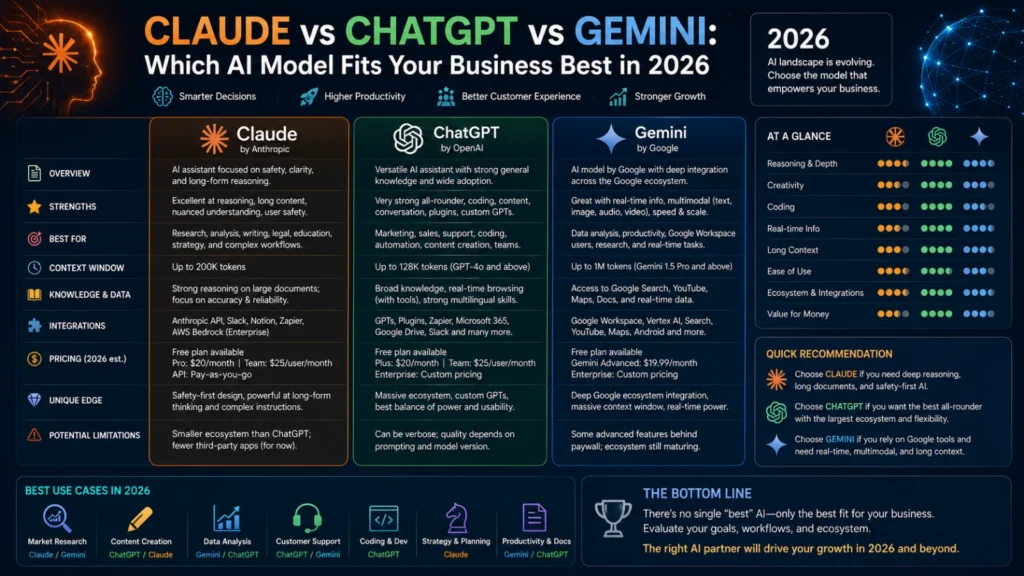
Most businesses now use at least one major AI assistant somewhere in their workflow. The harder question isn’t whether to adopt one. It’s which platform actually fits your specific use case best.
Claude, ChatGPT, and Gemini all get frequent updates. Specific benchmark scores and version numbers shift within months. This comparison focuses on the more durable differences instead — positioning, ecosystem fit, and practical strengths that tend to hold steady.
The Core Philosophy Behind Each
Anthropic built Claude with a strong emphasis on safety and careful reasoning. That shows up in longer, more deliberate responses for complex tasks. It’s also reflected in Anthropic’s public commitment to responsible AI development.
OpenAI’s ChatGPT has focused heavily on broad versatility and rapid feature expansion. It was also first to popularize the conversational AI assistant format widely. That head start still shapes how many people expect an AI assistant to behave.
Google’s Gemini leans into deep integration with Google’s existing product ecosystem. Search, Docs, Gmail, and Android all connect to it natively. That gives it a distinct advantage for anyone already living inside Google’s tools.
Where Each Tends to Shine
Claude has built a strong reputation for careful, nuanced writing and analysis. It’s often preferred for tasks needing extended reasoning over long documents. Coding, legal analysis, and detailed document review are common strong use cases. Claude also integrates directly into developer workflows through the Claude Agent SDK and API.
ChatGPT remains extremely versatile across a huge range of everyday tasks. Its plugin and app ecosystem is genuinely extensive at this point. That makes it a strong general-purpose choice for teams wanting broad flexibility. Voice mode and image generation are also well integrated into the main product.
Gemini’s biggest advantage is native integration with everyday Google Workspace tools. If your team lives in Gmail, Docs, and Sheets, that matters a lot. It can also pull in real-time information through Google’s search infrastructure directly. That’s useful for tasks needing current, up-to-date information baked into the response.
Pricing and Accessibility
All three offer free tiers alongside paid plans with more capability. Paid tiers generally unlock more advanced models, higher usage limits, and extra features. Enterprise pricing for all three typically scales with usage and seat count. Exact pricing details change often enough that checking each provider’s current page is wise.
Claude is also accessible through the Claude Developer Platform for teams building custom tools. Both ChatGPT and Gemini offer comparable developer APIs and enterprise integration options. None of the three is dramatically cheaper than the others at equivalent capability tiers.
Ease of Use and Team Fit
ChatGPT’s interface remains famously simple and approachable for non-technical users. That’s a big reason it became the default AI assistant for so many people. Gemini’s interface is similarly approachable, especially for anyone already comfortable in Google’s ecosystem. Claude’s interface is clean and straightforward too, with less emphasis on flashy extras.
For technical teams, Claude Code and the Claude Agent SDK offer strong developer-focused tooling. ChatGPT’s Custom GPTs and plugin ecosystem offer similar customization for non-coding teams. Gemini’s deepest customization currently comes through Google’s broader cloud and Workspace admin tools.
Data Privacy and Enterprise Considerations
All three providers offer enterprise agreements with stronger data handling commitments than free consumer tiers. Anthropic has generally emphasized privacy and safety commitments prominently across its documentation and policies. OpenAI and Google both offer enterprise-grade data protections through their respective business tiers too. Any business handling sensitive data should review the specific enterprise terms directly. Don’t assume default free-tier policies for that provider apply automatically.
Which One Actually Fits Your Business?
f your team does heavy writing, coding, or detailed document analysis, Claude is a strong fit. It’s particularly well suited to work needing careful reasoning over long, complex material.
If you want broad, flexible, general-purpose AI across many different tasks, ChatGPT remains a safe choice. Its ecosystem of plugins and integrations is genuinely hard to match right now.
If your team already runs on Google Workspace daily, Gemini’s native integration is a real advantage. That’s especially true if you need AI woven directly into Docs, Sheets, and Gmail.
The Bottom Line
None of these three platforms is a universal “best” choice for every business. Each is built around a genuinely different set of priorities and strengths. Claude leans toward careful reasoning and developer-friendly tooling for complex work. ChatGPT leans toward broad versatility and an extensive plugin ecosystem. Gemini leans toward deep integration with Google’s everyday productivity tools. Given how quickly all three keep evolving, treat any specific comparison as a snapshot. It’s worth testing your actual use case directly before committing long-term.
Frequently Asked Questions
Can I use more than one of these AI platforms at the same time?
Yes, and many businesses do exactly that. It’s common to use Claude for detailed writing or coding work. Then use Gemini for quick tasks inside Google Workspace day to day. There’s no technical conflict in running multiple AI tools across different parts of a business.
Which one is best for customer service automation?
All three can power customer service chatbots and support automation reasonably well. The better question is which one integrates most easily with your existing support stack. ChatGPT’s plugin ecosystem is broad, Gemini integrates tightly with Google tools, and Claude offers strong developer tooling through its API and Agent SDK.
Is Claude only useful for developers and technical teams?
No. Claude works well for general business writing, research, and analysis tasks too. It’s just particularly strong at more complex reasoning tasks compared to lighter, casual use cases. Non-technical teams use it regularly for reports, content drafting, and document review.
Do I need to worry about vendor lock-in with any of these?
Somewhat, especially around deep integrations like Gemini’s Workspace connections or custom-built ChatGPT plugins. Basic chat-based usage of any of the three is relatively easy to switch away from. Heavier API-based integrations naturally involve more switching cost the deeper you build on one platform.
Which platform is most cost-effective for a small business?
All three offer usable free tiers, so cost often depends on actual usage volume. Small teams doing light, occasional use may not need a paid tier at all initially. Heavier daily use across a team usually makes a paid or business tier worthwhile fairly quickly.
Do these AI models actually perform that differently in practice?
For many everyday tasks, the practical difference is smaller than marketing materials might suggest. Real differences tend to show up more in specific tasks, ecosystem fit, and workflow integration. That’s why testing your actual use case directly matters more than chasing a benchmark score.
