
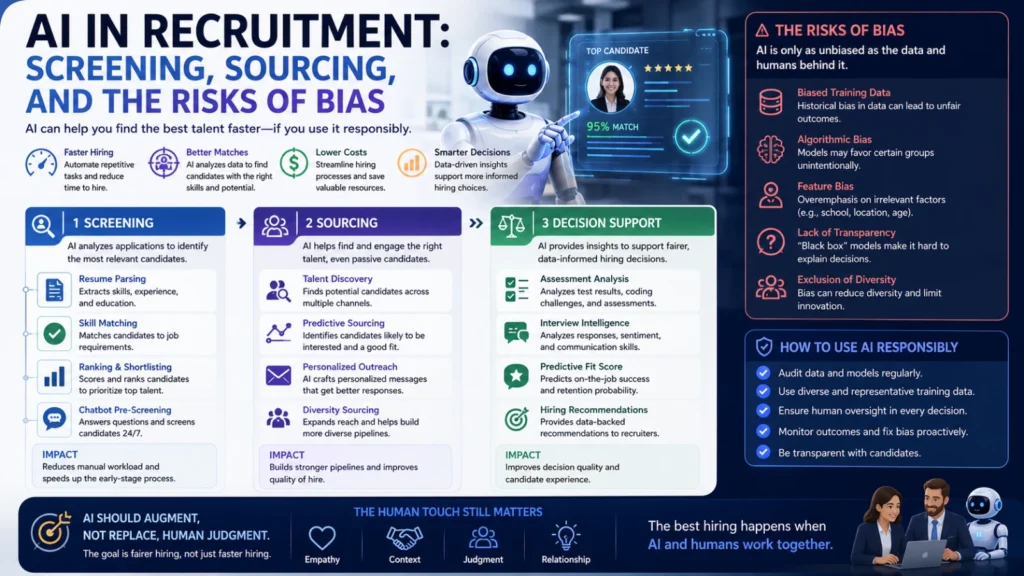
Recruitment has become one of the busiest areas for AI adoption in business. A single job posting can now generate hundreds of applications within days. Reviewing all of that manually simply isn’t realistic for most hiring teams anymore.
AI has stepped in to handle sourcing, screening, and initial candidate ranking at scale. That speed is genuinely valuable, but it comes with a real, well-documented risk. Poorly built AI hiring tools can quietly reproduce or even amplify human bias.
How AI Is Actually Used in Recruitment Today
Sourcing Candidates
AI-powered sourcing tools scan job boards, professional networks, and internal databases automatically. They identify people who match a role’s stated requirements far faster than manual searching. Some tools also proactively suggest passive candidates who haven’t even applied yet.
Resume Screening
This is probably the most widely used application of AI in hiring right now. Algorithms scan resumes for keywords, skills, and experience matching a job description. Recruiters get a shortlist instead of manually reading through hundreds of applications.
Chatbot-Based Initial Screening
Many companies now use AI chatbots for early candidate conversations before human involvement. These bots ask basic qualifying questions like availability, salary expectations, and location. That saves recruiter time for candidates who clearly meet the baseline requirements.
Video Interview Analysis
Some AI tools analyze recorded video interviews, assessing speech patterns, word choice, and sometimes facial expressions. This is genuinely one of the more controversial uses of AI in hiring today. It raises real questions about accuracy, fairness, and what’s actually being measured.
Predictive Analytics for Candidate Success
Certain platforms attempt to predict how likely a candidate is to succeed or stay long-term. These predictions are typically based on patterns from a company’s existing employee data. That data-driven approach carries its own significant risks, which we’ll cover shortly.
Why AI Hiring Tools Can Become Biased
AI systems learn patterns from historical data, and that’s exactly where bias creeps in. If a company’s past hiring favored certain demographics, the AI can learn to repeat that pattern. It doesn’t understand fairness; it only recognizes and repeats statistical patterns from training data.
A widely cited example involved an AI recruiting tool that learned to downgrade resumes mentioning women’s colleges. It wasn’t explicitly programmed to discriminate by gender at all. It simply learned that pattern from historical hiring data reflecting past human bias.
Bias can also creep in through seemingly neutral proxies for protected characteristics. Zip codes can correlate with race. Career gaps can correlate with gender or disability status. An AI model doesn’t need to “see” a protected trait directly to discriminate against it indirectly.
Where the Risks Are Most Serious
Resume screening algorithms can systematically filter out qualified candidates based on biased historical patterns. This often happens invisibly, since nobody manually reviews every rejected application afterward.
Video and speech analysis tools raise particular concern around accent, speech patterns, and neurodivergent communication styles. These traits have nothing to do with actual job performance in most roles.
Predictive success models risk baking in whatever biases already existed in a company’s past hiring decisions. If leadership has historically been demographically narrow, the model can learn to prefer similar candidates.
Sourcing algorithms can inadvertently show job ads to a narrower demographic than intended. This narrows who even sees an opportunity before any application is submitted.
How Companies Are Trying to Reduce These Risks
Regular bias audits have become a standard recommendation for any AI hiring tool. These audits test whether outcomes differ significantly across gender, race, age, or other protected groups. Some jurisdictions now legally require this kind of auditing for automated hiring tools.
Keeping a human genuinely involved in final decisions matters more than most companies realize. AI should narrow a pool or surface information, not make a final hiring decision alone.
Being transparent with candidates about AI’s role in the process is increasingly expected. Some regulations now require companies to disclose when AI is used in hiring decisions.
Diversifying the training data behind these tools helps, though it isn’t a complete fix. A model can still learn subtler patterns even from more demographically balanced data.
Testing with adversarial or edge-case resumes before deployment can surface hidden bias early. This means intentionally testing how the system treats resumes designed to probe for bias.
What This Means for Job Seekers
Candidates increasingly compete against algorithms before ever reaching a human reviewer. That’s a real shift in how job searching actually works today. Optimizing a resume for both human readers and algorithmic screening has become genuinely useful. This includes clear formatting, relevant keywords, and avoiding overly creative resume designs that confuse parsing software.
The Bottom Line
AI has made recruitment faster and more scalable, and that’s a genuine, measurable benefit. But speed and scale can just as easily amplify bias as they can improve efficiency. The businesses using AI responsibly in hiring keep humans meaningfully involved in final decisions. They also audit their tools regularly and stay transparent with candidates about how AI is used. Used carelessly, these same tools can quietly lock in exactly the bias they were meant to remove.
Frequently Asked Questions
Can AI hiring tools be completely bias-free?
Realistically, no tool can guarantee zero bias, since bias often comes from historical data. Regular auditing and human oversight significantly reduce risk, but eliminating it entirely isn’t currently achievable.
Is it legal to use AI for hiring decisions?
Generally yes, but regulations vary significantly by location and continue evolving quickly. Some jurisdictions now require bias audits or candidate disclosure specifically for automated hiring tools.
How can I tell if a company used AI to reject my application?
Many companies don’t disclose this directly, though some regulations increasingly require it. If you never hear from a company after applying, AI screening may well have been involved.
Should small businesses avoid AI recruiting tools due to bias risk?
Not necessarily, but smaller companies should still choose vendors carefully and understand how their tools work. Asking a vendor directly about bias testing and auditing practices is a reasonable, worthwhile step.
Does AI video interview analysis actually predict job performance accurately?
This remains genuinely controversial, with significant debate around its actual accuracy and fairness. Several major employers have scaled back or dropped these tools due to bias and validity concerns.
What’s the single most important safeguard against biased AI hiring?
Keeping a human genuinely involved in final decisions is widely considered the most important safeguard. AI should inform and support hiring decisions, not replace human judgment entirely on its own.
