
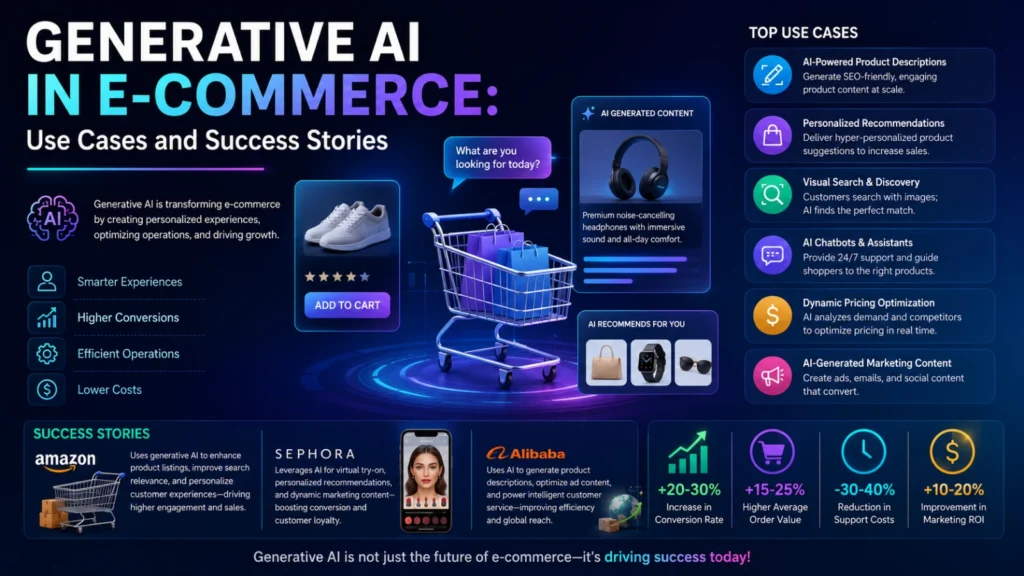
Generative AI has moved from an experimental novelty to a genuinely core part of how online retail operates — from the product page a shopper lands on, to the chatbot answering their question, to the recommendation that shows up right before checkout. Analysts across the industry expect continued strong growth in generative AI spend specifically within retail and eCommerce over the next several years, and the reason is straightforward: it’s one of the few technologies that touches nearly every part of the online shopping experience at once — content, personalization, customer service, and merchandising.
Here’s a practical look at how generative AI is actually being used in eCommerce today, with a close look at how Amazon in particular has rolled it out across its seller and shopper tools.
Where Generative AI Is Actually Showing Up in Online Retail
AI-Powered Shopping Assistants and Personalized Experiences
Conversational commerce has become one of the most visible applications. Rather than static FAQ pages or rigid chatbot scripts, generative AI powers shopping assistants that hold genuinely natural conversations — answering product questions, offering tailored suggestions, and adapting responses based on what a shopper has already browsed or purchased. This kind of always-available, conversational support tends to build stronger customer relationships than a traditional static help center ever could.
AI personal shoppers address a genuinely common frustration: online catalogs often treat overlapping searches (say, matching an outfit or building a themed gift set) as separate, disconnected queries. Generative AI can hold context across a shopping session, remembering preferences as a customer browses and making the overall experience feel more like working with an actual personal shopper than filtering through a static catalog.
Personalized product recommendations are a natural extension of this. Personalized messaging and suggestions consistently outperform generic ones, and generative AI makes it possible to generate those recommendations dynamically — surfacing product cards through a chatbot interface tailored to a specific shopper’s browsing and purchase history, rather than a one-size-fits-all “customers also bought” list.
Upselling and cross-selling benefit from the same underlying capability. A chatbot that notices a shopper has added one item to their cart can naturally suggest a complementary product in a conversational, helpful tone rather than a pushy pop-up — closer to how a good in-store associate would make a suggestion. Retailers using AI-driven chat interfaces for this kind of prompting have reported meaningful lifts in incremental sales as a result.
AI for Smarter Product Discovery and Purchase Decisions
Review aggregation solves a real pain point in online research — comparing a product across multiple retail sites to get a full picture of quality and reliability. Generative AI can pull and summarize reviews from across the web into a single conversational answer, saving a shopper from tab-hopping across five different sites to make a decision.
Price comparison works similarly — an AI assistant can surface pricing for a given product across multiple sellers on the same platform, giving shoppers a clear, at-a-glance comparison rather than requiring manual searching.
Natural language product search is one of the more genuinely useful applications for shoppers who don’t know exact product names. Someone can describe what they want in plain language — a style, a rough budget, a general look — and a generative AI-powered search can interpret that intent and surface relevant matches, rather than requiring exact keyword matches the way traditional search often does.
Stock and restock notifications get a personalization boost too — rather than generic “back in stock” blasts, AI-driven notification systems can tailor alerts to a shopper’s specific interests and past engagement, making the messaging feel relevant rather than spammy.
Price history and pricing context round out the picture — AI-powered assistants can surface messaging like “lowest price in X days,” giving shoppers real-time context that builds confidence in a purchase decision and reduces the odds of a later return once someone learns they could have gotten a better deal.
How Amazon Has Rolled Out Generative AI for Sellers and Shoppers
Amazon offers one of the clearer real-world pictures of generative AI adoption at scale in eCommerce, spanning both the seller and shopper sides of the platform.
Project Amelia functions as a kind of personalized business advisor for sellers — surfacing sales trends, flagging potential issues, and answering direct questions like “how is my business doing” with tailored insight drawn from that seller’s actual account data, available on demand through Seller Central.
AI-generated product listings let sellers turn a short description, a product link, or even just an image into a fully structured listing automatically — a meaningful time-saver for sellers managing large catalogs, and a feature that’s seen substantial adoption since launch, with Amazon continuing to expand bulk-listing capabilities for sellers managing larger catalogs.
A+ Content tools help brands build richer product pages — image carousels, comparison charts, brand storytelling — that previously required a full production process (photography, copywriting, design, testing) to put together. AI tools now streamline much of that process, making richer, more persuasive product pages accessible to sellers who don’t have a full creative team behind them. Brands using A+ Content have historically seen conversion improvements as a result.
Personalized recommendations and descriptions get sharper through generative AI as well — rather than generic suggestions, the system can surface specifically timed and targeted recommendations (a seasonal gift guide, dietary-specific search terms baked into descriptions) based on actual shopper behavior, which matters especially for the large share of shopping now happening on mobile.
AI-generated video ads are a newer addition — tools that let sellers turn a single product image into a short video advertisement automatically, using retail-specific insight to highlight relevant features without requiring a video production budget or team.
What This Means for Retailers Building Their Own AI Strategy
Businesses don’t need Amazon’s scale to benefit from the same underlying technology. Integrating capable AI models into an existing eCommerce operation can meaningfully reduce manual work around product descriptions, blog content, and marketing copy, while conversational AI chatbots handle a real share of customer questions instantly rather than routing everything to a human support queue.
On the analytical side, AI-driven demand forecasting and pricing support help retailers stay ahead of shifting demand rather than reacting after the fact, and generative image tools can produce product visuals and ad creative faster than a traditional production pipeline.
For any business considering adding generative AI to an existing chatbot or customer-facing tool, a proof-of-concept phase before full launch is generally the sensible approach — testing the integration against real customer queries before rolling it out broadly, rather than committing fully on day one.
The Bottom Line
Generative AI in eCommerce isn’t a single feature — it’s a layer that touches nearly every part of the shopping experience, from how a product is described to how a recommendation is surfaced to how a customer question gets answered. Amazon’s rollout across seller tools and shopper-facing features offers a useful blueprint, but the underlying capabilities are increasingly accessible to retailers of any size. The businesses seeing real results tend to be the ones treating this as an ongoing capability to build into their operations, rather than a one-time feature to bolt on and forget.
Frequently Asked Questions
How is AI used in eCommerce generally?
It speeds up decision-making by finding patterns in customer data and predicting behavior — what someone is likely to buy, when they’re likely to buy it, and what messaging will resonate.
Can AI build an eCommerce website from scratch?
AI-powered website builders can get a basic store running quickly without requiring coding knowledge, though more complex or highly customized stores generally still benefit from dedicated development work.
How is generative AI specifically different from other AI use in eCommerce?
Generative AI focuses on creating new content and recommendations dynamically — copy, images, personalized messaging, promotional ideas — rather than just classifying or scoring existing data.
How big is the AI-driven eCommerce market?
Industry estimates vary, but most forecasts point to continued strong, sustained growth in AI adoption across online retail over the next several years, driven largely by personalization and customer service use cases.
