
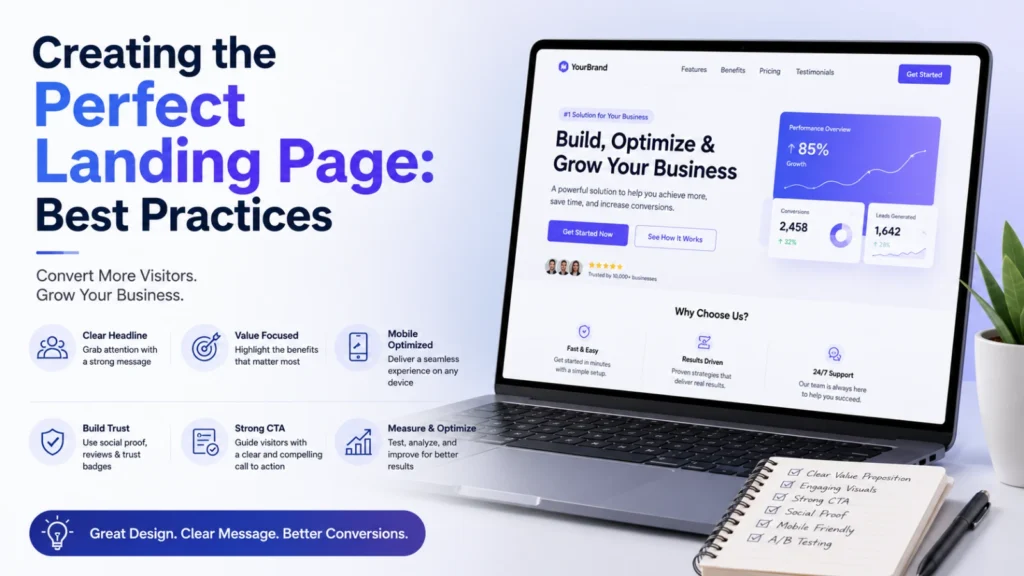
A landing page has one job, unlike a regular website page. It exists to move a visitor toward one specific action. Most landing pages fail because they try to do too much. Here’s what actually makes one convert consistently.
Start With One Clear Goal
Every effective landing page focuses on a single, specific conversion goal. Trying to sell, collect emails, and book demos confuses visitors instantly. Pick one outcome, then build every element around supporting it directly. A focused page consistently outperforms one trying to do everything at once.
Write a Headline That Actually Says Something
Visitors decide whether to stay within seconds of landing on a page. A vague, clever headline wastes that critical first impression entirely. State the specific benefit clearly, without forcing visitors to guess your meaning. Clarity beats cleverness almost every time on a landing page.
Put the Real Value Above the Fold
Visitors shouldn’t have to scroll to understand what you’re actually offering. The headline, core benefit, and primary call-to-action belong near the top. This is where most visitors decide whether to continue or leave immediately. Burying your value proposition costs you conversions before visitors even scroll down.
Remove Anything That Isn't Necessary
Standard website navigation gives visitors an easy way to leave the page. A landing page should remove distractions, not offer extra exits. Cut unnecessary links, unrelated content, and competing calls-to-action entirely. Every removed distraction slightly increases the odds someone completes your intended action.
Use Real Social Proof, Not Generic Claims
Testimonials, reviews, logos, or specific numbers build trust far faster than adjectives. Vague claims like “trusted by many” convince almost no one seriously. Specific, credible proof reassures visitors that others found real value here. Place this proof near your call-to-action, where hesitation typically happens.
Match the Page to the Ad or Link That Sent Them
A visitor clicking a specific offer expects to see that exact offer. Mismatched messaging between an ad and landing page increases bounce rates significantly. Keep language, imagery, and offers consistent from click to landing page. This alignment, called message match, meaningfully improves conversion rates.
Reduce Friction in Every Form You Use
Every extra form field is a small reason for someone to leave. Ask only for information you genuinely need at this specific stage. Long, complicated forms consistently reduce completion rates across nearly every industry. A shorter form almost always outperforms a longer one, all else equal.
Make the Call-to-Action Impossible to Miss
Your primary call-to-action should stand out visually from everything else. Use clear, action-oriented text instead of vague words like “submit.” Repeat the same call-to-action at logical points down the page. Visitors shouldn’t have to search for what you actually want them to do.
Optimize for Speed and Mobile Devices
A slow-loading landing page loses visitors before they even see your offer. Mobile visitors now make up a large share of most traffic. Test your page across devices, and fix anything that feels clunky. Speed and usability directly affect conversion rates, not just user experience.
Test, Measure, and Keep Improving
No landing page is perfect on the first attempt, ever. Test headlines, images, form length, and call-to-action wording over time. Small changes can produce surprisingly large differences in conversion rates. Treat your landing page as an ongoing project, not a finished asset.
The Bottom Line
A great landing page isn’t about looking impressive; it’s about converting well. Clear goals, strong headlines, real proof, and reduced friction all matter significantly. Message match and mobile performance often decide success before visitors even engage. Built and tested this way, a landing page becomes a real growth tool.
Frequently Asked Questions
How long should a landing page actually be?
Length depends on the offer’s complexity and price point. Simple offers need less; considered purchases often need more explanation.
Should a landing page include site navigation?
Generally, no. Removing navigation reduces distractions and keeps visitors focused. This typically improves conversion rates noticeably.
How many calls-to-action should one landing page have?
Ideally, just one specific goal, repeated at logical points. Multiple competing goals usually confuse visitors and reduce conversions.
Does page load speed really affect conversions that much?
Yes, significantly. Slow-loading pages lose visitors before they engage with your offer. Speed directly impacts conversion rates.
What’s the biggest mistake businesses make with landing pages?
Trying to accomplish too many goals on a single page. Focus consistently outperforms trying to cover everything at once.
How often should I test and update my landing page?
Regularly, especially after major traffic or offer changes. Ongoing testing typically reveals meaningful, incremental improvements over time.
