
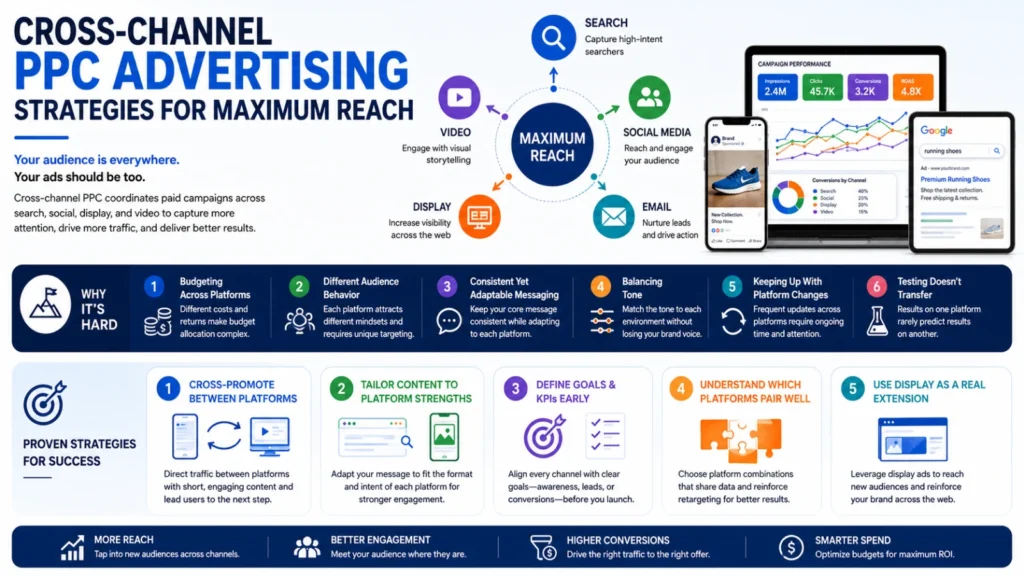
Audiences no longer live on a single advertising platform. Search, social, display, and video all reach different segments differently. Running PPC on just one channel leaves real reach untapped. Here’s how to approach cross-channel PPC without losing control.
What Cross-Channel PPC Actually Means
Cross-channel PPC coordinates paid promotion across multiple platforms simultaneously. This includes search engines, social media, display networks, and video. The logic is simple: your audience is genuinely spread out. A single-channel strategy inevitably misses a meaningful share of prospects.
Why This Approach Is Harder Than It Sounds
Coordinating multiple platforms takes more strategic thought than one campaign. This complexity is exactly why many cross-channel efforts underdeliver. Success requires planning, not just duplicating the same ad everywhere. Understanding the real challenges upfront prevents wasted budget later.
Challenge One: Budgeting Across Different Platforms
Every platform has a different cost structure and return path. Deciding how much to invest in each channel is genuinely difficult. Simple, even splits rarely reflect actual platform performance or potential. Budget allocation should follow data, not assumptions or convenience.
Challenge Two: Audiences Behave Differently by Platform
Different platforms attract fundamentally different user mindsets and behavior. A professional networking platform draws different intent than casual social scrolling. One audience persona rarely transfers cleanly across every channel. Each platform often needs its own version of the target audience.
Challenge Three: Keeping Messaging Consistent Yet Adaptable
Your core brand message needs consistent substance across every platform. But formats, norms, and rules differ significantly between channels. Uniform execution is genuinely harder than it initially appears. Consistency in meaning matters more than identical creative execution.
Challenge Four: Balancing Tone Across Different Environments
A formal, professional tone can feel stiff on casual platforms. A casual, visual tone can feel out of place elsewhere too. Staying recognizably on-brand while adapting takes real editorial judgment. This isn’t solved by simply resizing the same graphic.
Challenge Five: Keeping Up With Platform Changes
Ad formats, algorithms, and features change constantly across every platform. Cross-channel campaigns multiply the cost of falling behind these changes. Staying current means tracking updates across several platforms at once. This demands more ongoing attention than single-channel management.
Challenge Six: Testing Doesn’t Transfer Between Platforms
A/B testing is standard practice in any solid PPC strategy. Results from one platform rarely predict results on another platform. Algorithms, formats, and audience behavior all differ significantly. Genuine cross-channel testing requires separate testing cycles per platform.
Strategy One: Cross-Promote Between Platforms Deliberately
Don’t treat each channel as a fully separate campaign. Direct traffic between platforms using short, attention-grabbing content intentionally. Point viewers toward a fuller offer or conversion elsewhere. This turns disconnected channels into one connected customer journey.
Strategy Two: Tailor Content to Each Platform’s Strengths
Keep your underlying message consistent, but adapt its actual execution. Use a punchy, keyword-driven approach for search advertising specifically. Use visual, immediate content for social feeds instead. Resizing one asset everywhere rarely performs as well as rethinking format.
Strategy Three: Define Goals and KPIs Before Launching
Cross-channel campaigns are hard to evaluate without shared success metrics. Decide upfront whether you’re optimizing for awareness, leads, or conversions. This keeps every platform’s efforts pointed toward the same outcome. Defining success after launching makes honest evaluation nearly impossible.
Strategy Four: Understand Which Platforms Pair Well
Some platform combinations naturally reinforce each other through shared data. Others don’t connect cleanly and simply duplicate spend instead. Knowing which pairings strengthen retargeting improves overall campaign efficiency. This understanding meaningfully reduces wasted advertising spend.
Strategy Five: Use Display Advertising as a Real Extension
Display ads reach audiences that search and social ads miss entirely. Banners, native placements, and in-app formats extend visibility further. They’re particularly effective for reinforcing brand presence across the wider web. Treat display as genuine reach extension, not an afterthought.
The Bottom Line
Cross-channel PPC is genuinely more complex than single-channel advertising. That complexity is the cost of reaching a spread-out audience properly. Success depends on consistent goals, tailored content, and deliberate cross-promotion. Done with real intention, cross-channel PPC becomes a genuine visibility multiplier.
Frequently Asked Questions
Why is budget allocation so difficult in cross-channel PPC?
Every platform has different costs and return paths. Even, simple splits rarely reflect actual platform performance.
Do audiences behave the same way across every platform?
No. Different platforms attract different user mindsets and behavior. Audience personas often need platform-specific adjustments.
Can the same ad creative work across every channel?
Not usually. Formats and audience expectations differ significantly by platform. Tailored content generally performs better than resized assets.
Should A/B testing results transfer between platforms?
No. Algorithms and audience behavior differ across platforms significantly. Separate testing cycles per platform produce more reliable results.
Why does display advertising matter in a cross-channel strategy?
It reaches audiences that search and social ads often miss. This extends brand visibility across the wider web.
What’s the biggest mistake businesses make with cross-channel PPC?
Duplicating the same ad across every platform without strategy. Real coordination and platform-specific tailoring drive better results.
