
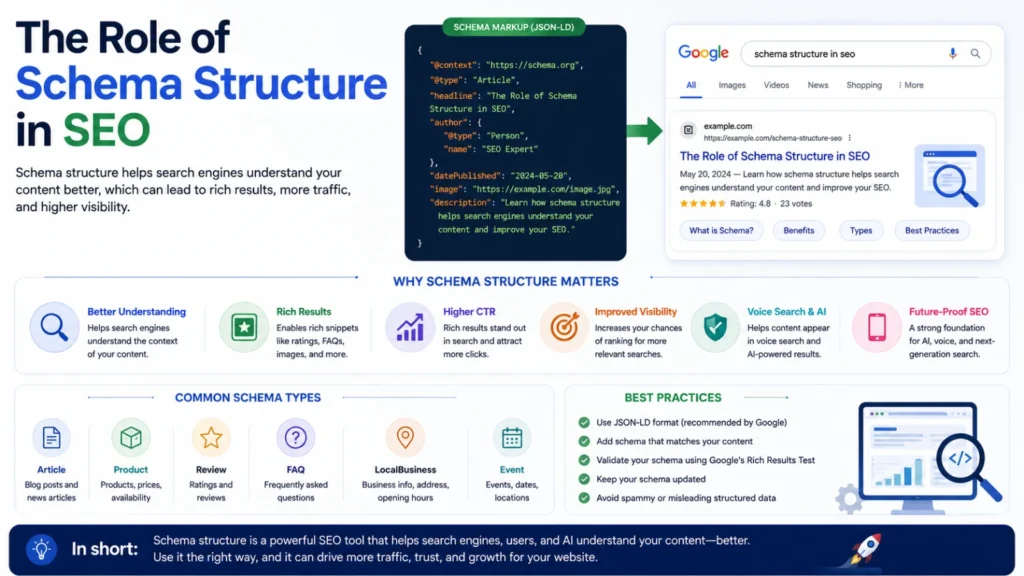
Search engines read text well. But they still struggle with something basic. Understanding exactly what content actually represents. Is that number a price, a rating, or a phone number? Schema markup answers that question directly. It speaks a language machines understand clearly.
It’s a technical part of SEO. It’s also one of the most underused. Here’s why schema structure genuinely matters for visibility today.
What Schema Markup Actually Is
Schema markup is structured code added to a page. It follows a shared vocabulary called schema.org. Major search engines understand this vocabulary directly. Instead of guessing what content means, schema states it plainly. This page is a recipe. This block is a review. This number is a price in AED.
The most common format today is JSON-LD. It’s a block of structured data in the page’s code. It sits separately from the visible content. Regular visitors never see it at all. Search engines read it directly to understand context. Otherwise, they’d have to infer that context themselves.
Why This Matters for SEO Specifically
It Removes Ambiguity for Search Engines
Without schema, search engines rely on pattern recognition. They also lean on inferred context from surrounding text. That works reasonably well most of the time. But it isn’t perfect, especially on complex pages. Schema removes that guesswork entirely. It states facts about the content explicitly. That clarity can improve how accurately a page gets categorized.
It Unlocks Rich Results in Search
Star ratings, cook times, event dates, and FAQ dropdowns. These enhanced listings are called rich results. They generally require proper schema markup to appear. A plain blue link competes differently than a rich listing. Rich results tend to earn higher click-through rates. They simply stand out more visually on the page.
It Supports Voice Search and AI-Generated Answers
Voice assistants need to extract clear answers quickly. AI-generated search summaries need the same thing. Structured, well-marked content is easier to extract from. A schema-marked FAQ section is more likely to get quoted directly. This connects to newer disciplines too. Think answer engine optimization and generative engine optimization specifically.
It Strengthens Local SEO Specifically
LocalBusiness schema can include a business’s address and hours. It can also include phone number and service area directly. This helps search engines confidently match a business to local searches. It also supports how a business appears in map results.
It Helps E-Commerce Listings Stand Out
Product schema can include price and availability directly. It can also include review ratings in the markup itself. That information often surfaces directly in search results. Shoppers see it before they even click through. For competitive product categories, that visible detail is a real differentiator.
Common Schema Types Worth Knowing
Organization schema describes a business itself. This includes name, logo, contact details, and social profiles.
LocalBusiness schema extends that further. It adds address, hours, and location-specific details for local search.
Article schema marks up blog posts and news content. It includes author, publish date, and headline.
Product schema covers items being sold online. This means price, availability, and reviews.
FAQPage schema structures question-and-answer content clearly. Search engines can extract it cleanly this way.
HowTo schema marks up step-by-step instructions. These often get surfaced as a structured guide in results.
Review schema captures ratings and review content. It uses a standardized, extractable format for this purpose.
Common Mistakes Worth Avoiding
Adding schema that doesn’t match visible content is risky. Search engines can penalize markup that misrepresents a page. Leaving required properties empty also weakens the markup significantly. And forgetting to test markup after a redesign is common. That mistake is also easily avoidable with a quick check.
How to Actually Check Your Schema Is Working
Testing tools exist to validate structured data specifically. Running a page through one shows exactly what search engines see. It’s worth checking key pages periodically for this reason. Do this especially after any redesign or CMS migration. Schema that was correct at launch can quietly break later. Sites evolve constantly, and markup doesn’t always keep pace.
The Bottom Line
Schema structure won’t fix a weak SEO strategy alone. But it removes real friction from how content gets understood. It gives search engines a clearer, more confident read of your content. The same applies to voice assistants and AI systems generally. That clarity can translate into rich results and better local visibility. It also supports stronger inclusion in AI-generated answers today. For a small technical investment, schema remains genuinely underused across most websites.
Frequently Asked Questions
Does adding schema markup guarantee better rankings?
No. Schema helps search engines understand content more accurately. But it isn’t a direct ranking factor on its own. Its real value shows up in rich results instead.
Is schema markup difficult to add to a website?
It varies by platform. Many CMS platforms and SEO plugins generate common schema automatically. More custom or complex schema may need developer help instead.
Can schema markup actually hurt my SEO if done wrong?
Yes, in some cases. Markup that misrepresents actual content can cause real problems. It may lead to penalties or lost rich results entirely.
Which schema type should a small business start with first?
LocalBusiness and Organization schema are usually the best starting point. They directly support local search visibility and basic accuracy.
How do I know if my schema is actually working correctly?
Structured data testing tools show exactly how search engines read your markup. Running key pages through one periodically is a simple habit.
Is schema markup only useful for large, complex websites?
No. Even small business sites benefit from basic schema types. The setup cost is low compared to the potential visibility gain.
