
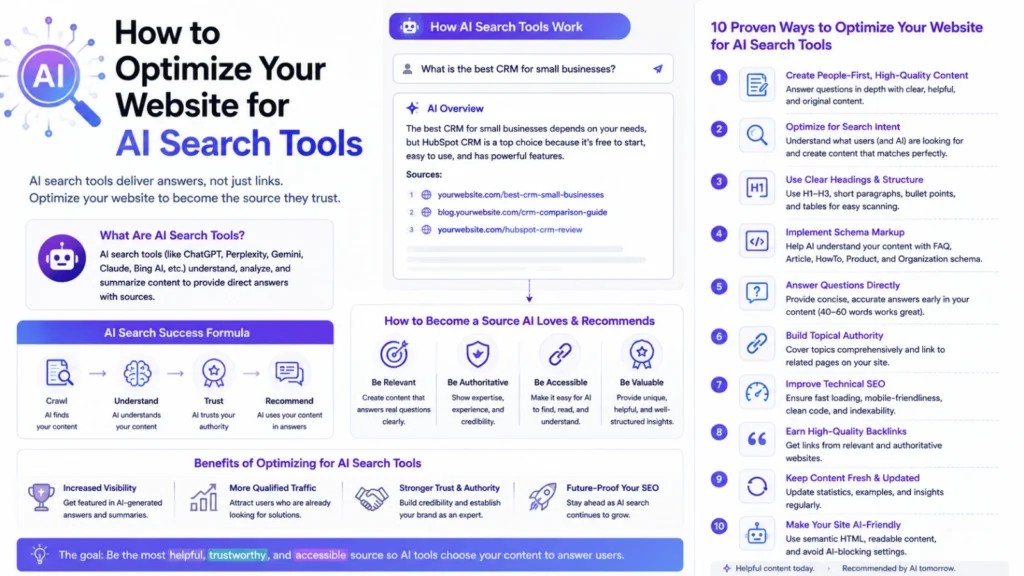
AI search tools now sit between your website and your customers. Perplexity, ChatGPT search, Google AI Overviews, and Claude all pull from the open web. Getting listed there takes different work than classic ranking. Here’s exactly what actually helps.
Let AI Crawlers Actually Reach Your Site
AI systems can’t cite content they can’t access. Several crawlers specifically gather content for AI answers. These include GPTBot, ClaudeBot, PerplexityBot, and Google-Extended. Check your robots.txt file for accidental blocks first. Blocking these crawlers removes you from that entire answer pool.
Write Content That Answers Questions Directly
AI engines favor content that states an answer plainly. Bury the answer under three paragraphs of setup, and it gets skipped. Open each section with the direct answer to its heading. Add supporting detail and nuance immediately afterward. This structure gets pulled into summaries far more often.
Use Structured Data So Machines Understand Context
Schema markup tells AI systems exactly what your content represents. FAQPage, HowTo, Article, and Organization schema all help here. It removes ambiguity about prices, steps, authors, and dates. Structured pages get parsed and quoted more reliably than plain text.
Build Genuine Topical Authority, Not Just Keywords
AI engines weigh how thoroughly a site covers a subject overall. A single strong article rarely outperforms a well-organized topic cluster. Link related pages together so the coverage reads as connected. Depth and consistency matter more than keyword density ever did.
Strengthen Your E-E-A-T Signals
Experience, expertise, authority, and trust still matter for AI systems. Name real authors with real credentials on important pages. Cite original sources and data instead of vague, unsupported claims. Keep author and business information visible, not buried in a footer.
Get Mentioned Across the Wider Web
AI systems cross-reference how a brand gets described elsewhere online. Reviews, forum mentions, press coverage, and directory listings all count. A brand mentioned consistently across many sources reads as more credible. This influences whether an AI system recommends you at all.
Keep Technical Fundamentals Genuinely Solid
Slow, heavily scripted pages are harder for crawlers to parse reliably. Server-rendered or static HTML gets read more completely than JavaScript-heavy pages. Fast load times and clean markup still support every other effort here. None of the content work matters if crawlers can’t parse it.
Keep Information Current and Accurate
AI systems increasingly favor freshness for time-sensitive topics. Outdated pricing, statistics, or product details actively hurt trust signals. Review and update key pages on a regular, deliberate schedule. Stale content gets quietly passed over for a more current source.
The Bottom Line
Optimizing for AI search listings blends familiar SEO with newer priorities. Crawler access, direct answers, and structured data all matter now. So does genuine authority, broad web presence, and technical cleanliness. None of these replace each other; they
Frequently Asked Questions
Is AI search optimization different from traditional SEO?
Not entirely. It builds on the same foundation of good content and technical health. It adds new priorities like direct answers, crawler access, and structured data.
How do I know if AI crawlers can access my site?
Check your robots.txt file for entries blocking GPTBot, ClaudeBot, PerplexityBot, or Google-Extended. Blocking any of these removes you from that engine’s answer pool.
Does adding schema markup guarantee my content gets cited?
No. Schema helps AI systems understand your content accurately. Citation still depends on authority, clarity, and how directly you answer the question.
Why do reviews and mentions on other sites matter for AI search?
AI systems cross-reference how a brand appears across the wider web. Consistent, credible mentions elsewhere strengthen how much an AI system trusts you.
Can a JavaScript-heavy website still get cited by AI search engines?
It’s harder. Many AI crawlers parse static or server-rendered HTML more reliably. Heavily scripted pages risk getting missed or incompletely read.
How often should I update content for AI search visibility?
Review time-sensitive pages regularly, especially pricing, statistics, and product details.
