
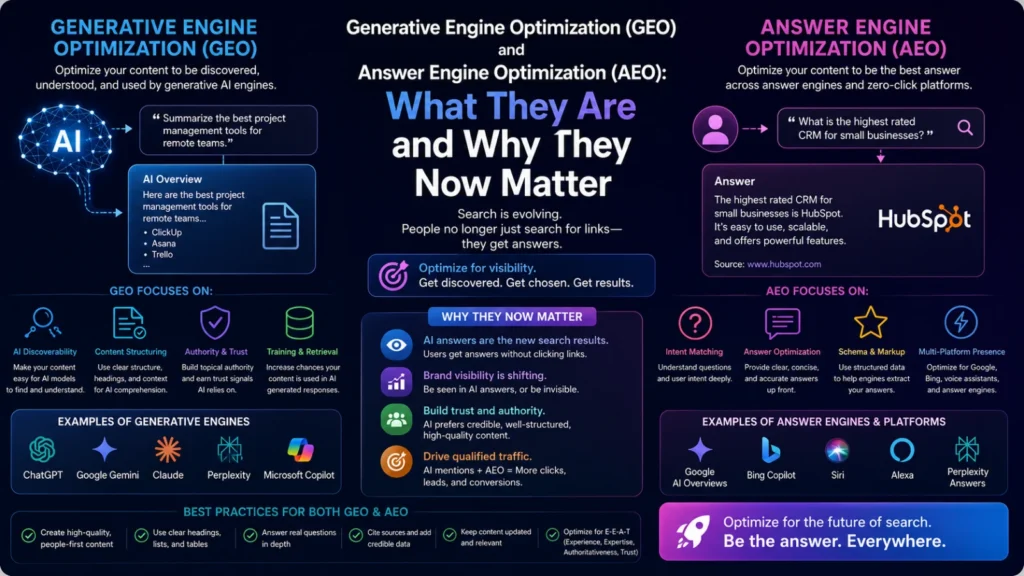
For twenty years, “search visibility” meant one thing: where a page landed on a results page full of blue links. That’s no longer the whole picture. AI-generated answers now appear across Google, ChatGPT, Claude, and Perplexity, reducing website clicks.
This shift introduced two key strategies: Generative Engine Optimization (GEO) and Answer Engine Optimization (AEO). Neither replaces traditional SEO, but both are quickly becoming necessary alongside it.
What Generative Engine Optimization Actually Is
GEO is the practice of optimizing content so that generative AI systems — the large language models behind ChatGPT, Google’s AI Overviews, Perplexity, Claude, and similar tools — are more likely to reference, cite, or directly recommend a brand, product, or piece of content when generating a response.
Unlike traditional search, where a ranking algorithm surfaces a list of links for a person to evaluate themselves, generative engines synthesize an answer and present it as a finished response. The content that fed into that answer either gets credited (a citation, a mention) or it doesn’t — there’s no ranked list for a user to scroll past a competitor to reach you. You’re either part of the synthesized answer or you’re invisible to it.
What Answer Engine Optimization Actually Is
AEO is closely related but slightly narrower in focus: it optimizes content to become the direct answer to a question, whether through a voice assistant, featured snippet, chatbot response, or the “answer box” results that increasingly appear above traditional search listings.
Where GEO focuses on becoming part of a generated response, AEO focuses more specifically on structuring content to directly and clearly answer a defined question — the kind of content that AI systems can lift verbatim or near-verbatim into an answer box because it already provides a clean, complete response.
In practice, the two overlap heavily. Content built well for AEO — clear, direct, well-structured answers to specific questions — also tends to perform well for GEO, since generative systems favor exactly that kind of unambiguous, extractable content when assembling a synthesized response.
Why Traditional SEO Isn’t Enough Anymore
Classic SEO optimizes for ranking algorithms that reward things like backlink authority, keyword density, and technical crawlability. Those signals still matter, but generative and answer engines weigh a somewhat different set of factors:
Clarity and extractability matter more than keyword placement. A ranking algorithm can infer relevance from surrounding context and backlink signals even from moderately dense, less direct writing. A generative model synthesizing an answer benefits far more from content that states a fact or answer plainly and early, without requiring inference.
Being cited beats being clicked. Traditional SEO success depends on clicks and rankings. GEO/AEO success depends on whether AI-generated answers mention or cite a brand or source — a fundamentally different kind of visibility that traditional traffic metrics often fail to capture.
Structured, factual accuracy carries more weight. Generative systems are more likely to draw on and cite content that reads as authoritative and verifiably accurate, since hallucination risk and factual reliability are active concerns for the systems generating these answers. Content that hedges vaguely or buries a direct answer in marketing language is less useful to synthesize from.
Consistency across sources reinforces trust. These systems often cross-reference multiple sources when forming an answer. AI systems are more likely to treat a brand or fact as reliable when companies state it consistently across their own sites, third-party mentions, review platforms, and structured data rather than when they assert it in only one self-published place.
Practical Tactics for GEO
Write in direct, quotable statements. Structure key facts, definitions, and claims as clear, complete sentences that make sense even when AI systems lift them out of context — because that often happens.
Build genuine topical authority, not just keyword coverage. Generative models tend to favor sources that demonstrate depth across a topic area, not just a single optimized page. A cluster of genuinely thorough, interlinked content on a subject signals authority more effectively than one heavily optimized page surrounded by thin, unrelated content.
Keep facts accurate and current. Outdated statistics or superseded claims create a liability in this context specifically — when a generative system cites an outdated figure and someone calls it out, the system has a direct incentive to prefer more reliably current sources over time.
Use structured data consistently. Schema markup (Organization, Product, FAQ, HowTo, and similar types) gives machines a clean, unambiguous read of what a page contains, which supports both traditional rich results and machine parsing more broadly.
Earn genuine third-party mentions. Accurate references on other credible sites — review platforms, industry publications, and comparison content — reinforce the cross-source consistency that generative systems seem to weigh when deciding what information to trust and cite.
Practical Tactics for AEO
Structure content around specific questions. Headings phrased as actual questions (“How much does X cost?” “What’s the difference between X and Y?”), followed immediately by a direct, complete answer in the first sentence or two, provide the clearest signal for featured snippets and generative answer extraction.
Answer first, elaborate after. Lead with the direct answer, then follow with supporting detail, context, or nuance. Answer engines and snippet algorithms both tend to favor content that doesn’t bury the actual answer under a long preamble.
Use lists and tables where the content genuinely fits that shape. Comparison data, step-by-step processes, and structured pricing information naturally support extraction when content creators format them as actual lists or tables rather than prose.
Include FAQ sections with real, specific questions. Generic questions produce generic, unhelpful answers. The most effective FAQ content mirrors the actual specific phrasing people search with, answered plainly and completely.
Mark up FAQ and HowTo content with schema. This doesn’t guarantee inclusion in an answer box, but it does make the question-answer structure machine-readable in an unambiguous way, which removes friction for both traditional snippet algorithms and generative extraction.
How to Think About Measuring This
Both disciplines are harder to measure than traditional SEO, largely because the feedback loop is less direct. A few practical approaches:
Track brand mentions and citations across major AI platforms manually or with an AI-visibility monitoring tool, since standard analytics won’t show a citation inside someone else’s chatbot conversation. Watch for changes in branded search volume and direct traffic, since an AI answer that cites a brand often drives people to search for that brand by name afterward rather than click through immediately. And treat this as a genuinely longer feedback loop than traditional SEO — visibility inside generative answers tends to shift more gradually and is harder to A/B test than a ranking position.
The Bottom Line
GEO and AEO don’t replace SEO — they extend it into a search landscape where users answer a growing share of queries without clicking at all. The underlying discipline that supports both is largely the same: clear, accurate, well-structured, genuinely authoritative content. What’s changed is that language models increasingly join the audience for that content, synthesizing answers alongside people who scan results pages — and writers now need to consider this second audience as a standard part of a serious content strategy rather than an experimental add-on.
Frequently Asked Questions
Is GEO just a rebrand of SEO?
No — it’s an extension, not a rebrand. Traditional SEO still governs whether a page ranks in classic search results, and most of the technical fundamentals (crawlability, site speed, structured data) still matter for both. GEO specifically addresses a different outcome: whether a generative AI system cites or references your content when synthesizing an answer, which involves somewhat different signals than ranking position alone.
Do I need to choose between optimizing for GEO/AEO and traditional SEO?
No, and trying to separate them cleanly isn’t really possible. Content that’s clear, accurate, well-structured, and genuinely authoritative tends to perform well across both. The practical shift is more about emphasis — writing more directly, answering questions plainly and early, and using structured data consistently — than building an entirely separate content track.
How Do I Know If AI Tools Are Citing My Content?
This is the hardest part to measure. Standard web analytics won’t show a citation inside someone else’s ChatGPT or Perplexity conversation. The practical options are manually testing relevant queries across major AI platforms to see what gets cited, using a dedicated AI-visibility monitoring tool, or watching for indirect signals like a rise in branded search volume or direct traffic following increased topical authority.
Does adding schema markup guarantee my content gets used in an AI-generated answer?
No. Schema markup (FAQ, HowTo, Product, Organization) makes your content’s structure unambiguous to machines, which removes friction for extraction — but it doesn’t guarantee selection. Generative systems weigh many factors, including topical authority, factual accuracy, and cross-source consistency, alongside how cleanly the content is structured.
Is AEO only relevant for voice search?
No — that’s a common misconception left over from when “answer engine optimization” was mostly discussed in the context of voice assistants. Today it applies just as much to featured snippets, AI Overviews, and chatbot responses in text-based interfaces, since all of these favor the same kind of direct, well-structured answer content.
Will GEO and AEO reduce my website traffic since users get answers without clicking through?
For some query types, yes — that’s a real and honest tradeoff, since a user who gets a complete answer inside a generative response has less reason to click through. The upside is that being cited as the source still builds brand visibility and trust, and often shows up later as increased direct or branded search traffic rather than an immediate click. It’s a different kind of visibility, not a strictly worse one, but it does require adjusting what success metrics you’re watching.
