
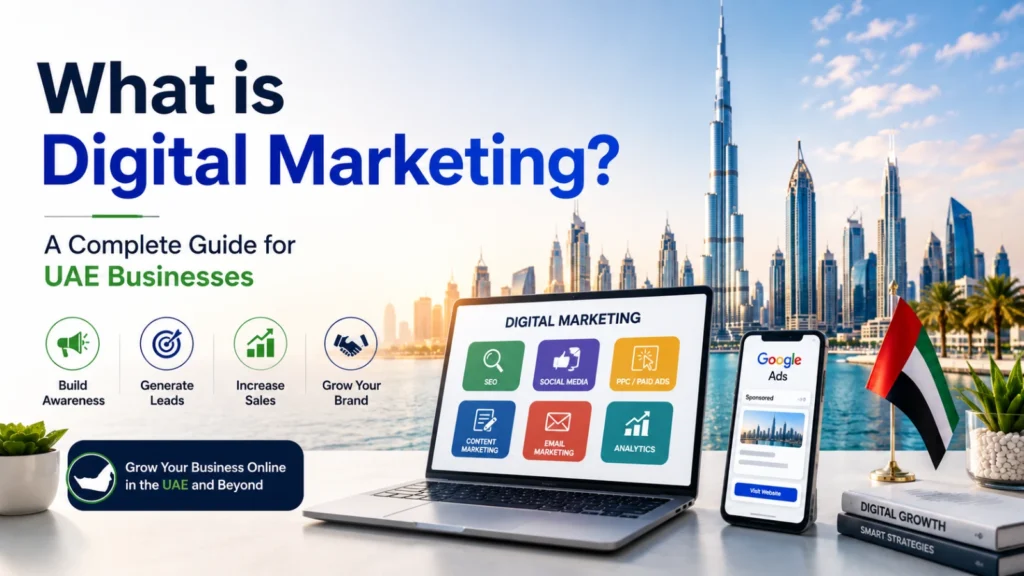
In 2026, digital marketing is essentially the system deciding who gets noticed, who gets skipped, and who ultimately gets chosen by an intensely connected consumer base. The UAE is a genuinely unusual market to operate in digitally — internet penetration sits above 99%, smartphone usage ranks among the highest anywhere in the world, and regional digital ad spend continues climbing past the multi-billion-dollar mark as both public and private sectors push digital transformation hard. Businesses that lean into data-driven digital marketing consistently outgrow competitors who don’t, often by a meaningful margin.
Shoppers across Dubai, Abu Dhabi, Sharjah, and the wider Emirates aren’t passive browsers anymore — they search with real commercial intent, compare across platforms instantly, and make purchase decisions on their phones in minutes. This guide walks through what digital marketing actually covers, how the UAE market behaves differently from others, what works by industry, and how to build and measure a strategy that actually moves revenue.
What Digital Marketing Actually Is
At its core, digital marketing means using online channels and connected devices to attract, engage, convert, and keep customers — search engines, social platforms, email, websites, apps, and messaging tools, all working as interconnected touchpoints rather than isolated tactics.
Unlike older, one-directional marketing, this is an ongoing conversation between a brand and its audience. It blends technical work (search optimization, paid ads) with more relational tactics (WhatsApp automation, influencer partnerships). In practice, it’s storytelling backed by real-time data — which means businesses can move away from guesswork and build campaigns grounded in what’s actually measurable.
How It Differs From Traditional Marketing
Traditional marketing broadcasts a single message to a broad, unsegmented audience through print, TV, radio, or billboards. Digital marketing does the opposite — it aims for precision, reaching the exact demographic or behavioral segment that actually matters to your business.
This distinction is especially sharp in the UAE, given the cost of physical infrastructure here and how the population is distributed. A billboard on Sheikh Zayed Road reaches millions of commuters a week, but only a small fraction of them match the buyer profile for a specialized B2B service or a niche luxury product. A well-targeted Google ad, by contrast, shows up exclusively for people actively searching for exactly what you offer, at the moment they’re searching for it. That precision is why businesses shifting budget toward digital consistently see better ROI and lower acquisition costs.
Why Every UAE Business Needs This Today
The UAE market moves fast, and foot traffic or legacy brand recognition alone doesn’t sustain market share anymore. The underlying consumer behavior makes this clear: the vast majority of UAE consumers research brands online before buying anything, most purchase journeys start with a search engine query, social media usage here ranks among the highest globally, and mobile-first behavior spans every age group and income bracket, not just younger demographics.
If a business lacks a genuinely optimized online presence, it simply doesn’t show up in the customer’s journey at all — effectively ceding the entire opportunity to competitors who are already there.
The Core Channels Every UAE Business Should Understand
Search Engine Optimization (SEO)
SEO is the practice of improving your web presence so you show up when people search for terms that matter to your business — keyword strategy, on-page optimization, content, and domain authority all play into it. In the UAE, competition in verticals like real estate, private healthcare, and fintech is genuinely intense, so a sustainable SEO foundation matters if you don’t want to be permanently dependent on rising ad costs.
Pay-Per-Click (PPC) and Google Ads
PPC and Google Ads buy immediate placement at the top of search results or across display networks, and you only pay when someone clicks. Cost-per-click in the UAE varies widely — commonly somewhere between AED 3 and AED 20+ depending on how competitive the keyword is. The upside is fast visibility and quick lead flow; the challenge is cost discipline, which is why the strongest performers pair paid campaigns with organic SEO rather than leaning on one alone.
Social Media Marketing
Social media marketing matters enormously here because the UAE is a genuinely social-first market — people use these platforms to discover businesses, not just to scroll for entertainment. Instagram tends to work best for lifestyle, luxury real estate, hospitality, and retail brands. LinkedIn is where B2B lead generation and enterprise relationships get built. TikTok and Snapchat drive viral discovery and fast brand recall, especially with younger and local Emirati audiences.
Content Marketing for Long-Term Growth
Content marketing helps businesses educate and engage their audience. It includes blogs, whitepapers, case studies, and explainer videos that address real customer needs. Helpful content builds trust and establishes authority. Unlike paid advertising, it continues to generate traffic and leads over the long term.
Email and WhatsApp Marketing
Marketing performance varies significantly between email and WhatsApp in the UAE. Email campaigns typically achieve 8–12% open rates, whereas WhatsApp messages commonly reach 60–90%. That gap is why local businesses are adopting conversational commerce and WhatsApp automation to drive conversions and retention.
Influencer Marketing in the UAE
Influencer marketing is highly regulated in the UAE. Success requires authentic audiences, genuine engagement, and localized content for your target community. Working with unverified influencers can quickly waste your marketing budget without delivering results.
Video Marketing
Video remains one of the highest-performing content formats online. Most businesses now consider it a core marketing tool, not an optional extra. Locally, polished short-form video is a genuine transaction driver in real estate, retail, and tourism specifically.
Marketing Analytics and Performance Measurement
Marketing analytics transforms guesswork into measurable results by tracking traffic sources, conversions, and ROI to improve budget decisions.
What Makes the UAE Market Genuinely Different
The population here spans over 200 nationalities, which means generic, one-size-fits-all campaigns tend to underperform. Real segmentation means English content for the expat population, native Arabic for Emirati citizens, and often specific language handling for large South Asian communities as well.
The market is also overwhelmingly mobile-first — desktop is often reserved strictly for office work — so every landing page and checkout flow needs to load fast and work flawlessly on a phone, with WhatsApp built in as a direct communication channel since local consumers genuinely expect it.
Social commerce adoption is unusually high here too. Instagram Shops and TikTok Shop are reshaping how people buy — discover a product in a video, tap the tag, check out without ever leaving the app.
And the calendar matters a lot. Ramadan brings a surge in late-night mobile engagement and gifting-driven searches. Dubai Shopping Festival drives intense retail competition and search volume spikes. GITEX is the anchor event for enterprise B2B tech lead generation. Campaigns that ignore this seasonal rhythm consistently leave revenue on the table.
What Works, by Industry
Financial and Professional Services
Fintech faces real trust and compliance hurdles under regulators like the DFSA and ADGM. LinkedIn builds institutional credibility, SEO around comparison keywords captures research-stage buyers, and educational content demystifies complex products.
Law firms often waste budget on generic corporate branding instead of capturing high-intent search. Local SEO around terms like “lawyer in Dubai,” a well-maintained Google Business Profile with genuine reviews, and plain-language legal content tend to outperform anything more abstract.
Retail, eCommerce, and Real Estate
Retail and eCommerce need an omnipresent approach — social commerce integration alongside optimized storefronts on regional marketplaces like Noon or Amazon — with campaigns built well in advance of major sales moments like White Friday, Ramadan, and 11.11.
Real estate serves two very different audiences — local residents and international investors — so paid search around off-plan and ready properties needs to be paired with immersive YouTube tours and TikTok walkthroughs that sell the lifestyle, not just the listing.
Healthcare and Public Sector
Healthcare operates under strict rules from bodies like DHA and MOHAP around what can be advertised. What works is empathetic, informational content around symptoms and treatments paired with accurate local clinic listings that drive real bookings.
Government entities focus on public awareness and service adoption, leaning on LinkedIn and X for announcements, accessible service portal SEO, and AI-driven WhatsApp chatbots to handle citizen queries at scale.
Education requires segmenting by audience — K-12 marketing to parents, executive education to working professionals, universities to international students — using targeted search terms, campus tour videos, and LinkedIn campaigns for advanced-degree programs.
Building a Strategy That Actually Works
A workable strategy generally moves through five stages. Start by defining specific, measurable goals — not “more visibility” but something like 250 qualified B2B leads a month or a defined percentage increase in eCommerce revenue. Then map out who you’re actually targeting, including language, cultural background, income level, and where they spend time online. Pick three channels that genuinely match how that audience behaves, rather than spreading thin across every platform. Build connected content across those channels so blogs, social posts, and paid ads all move a prospect toward the same outcome. And review performance regularly, shifting spend away from what isn’t working toward what is — weekly reviews are worth the discipline in a market that moves this fast.
What to Actually Measure
Track organic traffic, keyword rankings, and local pack visibility to measure SEO performance. Evaluate PPC campaigns by monitoring click-through rate (CTR), cost-per-click (CPC), conversion rate, and return on ad spend (ROAS). Measure social media success through engagement rate, reach, and share of voice compared with competitors. For email and WhatsApp campaigns, monitor open rates—email campaigns typically achieve around 8% in the region, while WhatsApp generally delivers much higher engagement. Across all marketing channels, customer acquisition cost (CAC) and customer lifetime value (CLV) remain the most important metrics for determining long-term marketing profitability.
Common Mistakes Worth Avoiding
A lot of local businesses neglect their Google Business Profile and local SEO entirely — keeping hours, contact details, and reviews current is basic but often skipped. Many also treat WhatsApp like an email blast list, which erodes trust fast; it works best as a personal, opt-in conversation channel, not a broadcast tool. Copying a Western campaign wholesale rarely translates — creative needs to reflect local cultural values and language, not just be a straight port. Skipping compliance checks on influencer partnerships is a real risk, given how tightly regulated the space is here. And a website or landing page that isn’t genuinely mobile-optimized will quietly tank performance in a market this mobile-first.
The Bottom Line
Digital marketing in the UAE has moved well past simple visibility — it’s now a precision discipline built on timing, cultural relevance, and accurate data. The businesses winning market share here follow a consistent pattern: start focused, measure everything, and optimize continuously. In a market that moves this fast, waiting to get started is usually the most expensive option available.
Frequently Asked Questions
What is digital marketing in simple terms?
It’s the practice of promoting and selling products or services through online channels — search, social, email, mobile apps — to reach a defined audience.
How much should a UAE business spend on digital marketing?
Most established businesses invest somewhere between 7% and 12% of revenue, though it varies by industry, growth stage, and competitive intensity.
Which channel works best in the UAE?
It depends heavily on the industry — SEO and Google Ads tend to convert best for high-intent categories like real estate and legal services, while Instagram and TikTok perform better for consumer retail and lifestyle brands.
Can small businesses actually compete here?
Yes — digital marketing genuinely levels the field, letting smaller, more agile businesses win through precise targeting, strong local SEO, and authentic content rather than sheer budget.
How long before results show up?
Paid campaigns can generate traffic almost immediately. Organic SEO authority typically takes 3–6 months of consistent work before it produces strong, durable results.
