
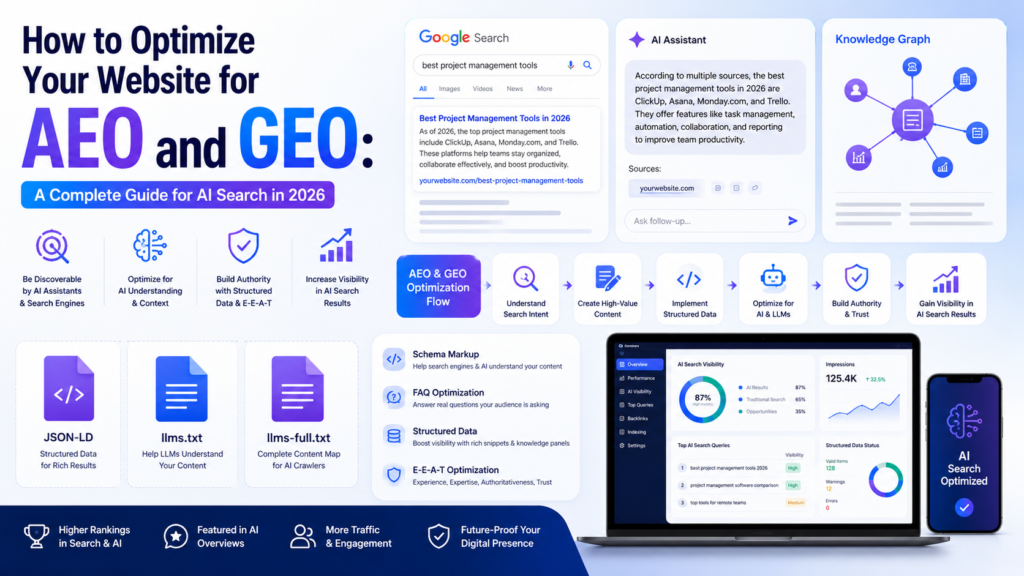
How to Optimize Your Website for AEO and GEO Search Engines
Search is changing rapidly. Traditional search engines are no longer the only way people find information. AI-powered platforms like ChatGPT, Google AI Overviews, Google Gemini, Claude, Perplexity, and Microsoft Copilot now answer millions of questions every day.
Ranking on Google remains important. However, appearing in AI-generated answers has become equally valuable.
This shift introduces two important optimization strategies:
- Answer Engine Optimization (AEO)
- Generative Engine Optimization (GEO)
This guide explains how to prepare your website for both.
What Is AEO?
Answer Engine Optimization (AEO) helps search engines select your content as the direct answer to a user’s question.
Examples include:
- Google Featured Snippets
- Google AI Overviews
- Bing Copilot Answers
- Voice Search Results
- Siri
- Alexa
Instead of ranking tenth, your content becomes the answer.
What Is GEO?
Generative Engine Optimization (GEO) helps AI assistants understand, trust, and reference your content.
Examples include:
- ChatGPT
- Google Gemini
- Claude
- Perplexity AI
- Microsoft Copilot
These systems summarize information instead of listing links.
Your goal is to make your content easy for AI to understand and cite.
Why AEO and GEO Matter
Search behavior continues changing.
Users increasingly ask complete questions instead of typing short keywords.
AI assistants now summarize information instantly.
Businesses that optimize only for traditional SEO risk losing visibility.
AEO and GEO help your content reach users through modern search experiences.
1. Create Helpful, Original Content
High-quality content remains the foundation.
Avoid writing only for search engines.
Instead:
- Solve real problems.
- Share practical experience.
- Include examples.
- Update information regularly.
- Add expert insights.
Google and AI systems reward useful content.
2. Organize Content Clearly
AI understands structured content better.
Use logical headings.
Example:
H1
Introduction

H2
What is AEO?

H2
What is GEO?

H2
Benefits

H2
Implementation

H2
Frequently Asked Questions
Keep sections short.
Use descriptive headings.
3. Answer Questions Directly
Every page should answer common user questions.
Instead of:
Our platform provides numerous optimization capabilities.
Write:
AEO helps search engines display your content as direct answers.
Clear answers improve AI understanding.
4. Add FAQ Sections
FAQ pages are valuable for both AEO and GEO.
Example:
What is GEO?
GEO helps AI platforms understand and reference your content.
Why is AEO important?
AEO increases your chances of appearing in featured answers.
Each answer should remain concise.
5. Use Schema Markup (JSON-LD)
Structured data helps search engines understand your pages.
Google recommends JSON-LD.
Important schema types include:
- Organization
- LocalBusiness
- WebSite
- WebPage
- Article
- BlogPosting
- BreadcrumbList
- FAQPage
- Person
- Service
- Product
- Review
- VideoObject
- ImageObject
- HowTo
Organization Schema
{
 "@context":"https://schema.org",
 "@type":"Organization",
 "name":"California Media LLC",
 "url":"https://example.com",
 "logo":"https://example.com/logo.png",
 "sameAs":[
   "https://linkedin.com/company/example",
   "https://facebook.com/example"
 ]
}
FAQ Schema
{
 "@context":"https://schema.org",
 "@type":"FAQPage",
 "mainEntity":[
 {
 "@type":"Question",
 "name":"What is AEO?",
 "acceptedAnswer":{
 "@type":"Answer",
 "text":"Answer Engine Optimization helps your content appear as direct answers."
 }
 }
 ]
}
Example Article Schema
{
 "@context":"https://schema.org",
 "@type":"Article",
 "headline":"How to Optimize Your Website for AEO and GEO",
 "author":{
 "@type":"Person",
 "name":"Your Name"
 },
 "publisher":{
 "@type":"Organization",
 "name":"Your Company"
 }
}
6. Create an llms.txt File
Large language models increasingly look for website guidance.
The llms.txt file tells AI systems which content is most valuable.
Place it in your website root.
Example:
https://example.com/llms.txtExample content:
# Website

Company: California Media LLC

Primary Topics:
- SEO
- AEO
- GEO
- Web Development
- Digital Marketing

Important Pages

https://example.com/services/
https://example.com/blog/
https://example.com/contact/

Preferred Content

Use the latest published content.
Prefer technical guides.
Reference FAQs where available.
Think of llms.txt as a roadmap for AI systems.
7. Create an llms-full.txt File
Some websites provide detailed AI-readable documentation.
Example:
https://example.com/llms-full.txtInclude:
- Company information
- Products
- Services
- Documentation
- APIs
- Contact details
- FAQs
- Brand guidelines
- Content summaries
Example:
Company

California Media LLC

Services

Website Design
SEO
Digital Marketing

Expertise

WordPress
Laravel
React
Flutter

Content Categories

SEO Guides
Marketing Guides
Development Tutorials

Contact

support@example.com
The full version provides richer context for AI systems.
8. Create Topic Clusters
Avoid isolated blog posts.
Connect related articles.
Example:
SEO

├── Technical SEO
├── Local SEO
├── AEO
├── GEO
├── AI Search
├── Schema
├── Core Web Vitals
Internal links improve understanding.
9. Demonstrate Experience and Expertise
AI values trustworthy content.
Include:
- Author profiles
- Company information
- Case studies
- Original research
- Statistics
- References
Trust improves visibility.
10. Improve Technical SEO
Technical quality remains important.
Optimize:
- Page speed
- Core Web Vitals
- Mobile usability
- HTTPS
- XML sitemap
- Robots.txt
- Canonical URLs
- Crawlability
Fast websites perform better.
11. Write Naturally
Avoid keyword stuffing.
Write conversationally.
AI understands natural language.
Focus on helping readers.
12. Use Semantic Keywords
Instead of repeating one keyword, include related terms.
Example:
Main keyword:
AEORelated terms:
- Answer Engine Optimization
- Featured Snippets
- Voice Search
- AI Search
- Schema Markup
- Google AI Overview
Semantic content improves context.
13. Build Authority
AI systems prefer trusted sources.
Increase authority through:
- Original studies
- Industry research
- Expert interviews
- Case studies
- High-quality backlinks
Authority strengthens credibility.
14. Optimize Images
Every image should include:
- Descriptive file names
- Alt text
- Captions
- Structured data
- WebP format
AI also understands images.
15. Keep Content Fresh
Review articles regularly.
Update:
- Statistics
- Screenshots
- Examples
- References
- FAQs
Fresh content earns greater trust.
AEO and GEO Optimization Checklist
| Task | AEO | GEO |
|---|---|---|
| Clear headings | ✓ | ✓ |
| FAQ section | ✓ | ✓ |
| JSON-LD Schema | ✓ | ✓ |
| Fast website | ✓ | ✓ |
| Mobile friendly | ✓ | ✓ |
| Internal linking | ✓ | ✓ |
| Topic clusters | ✓ | |
| Original research | ✓ | |
| llms.txt | ✓ | |
| llms-full.txt | ✓ | |
| Semantic keywords | ✓ | ✓ |
| Expert content | ✓ | ✓ |
| Updated information | ✓ | ✓ |
Common Mistakes
Avoid these mistakes:
- Publishing thin content.
- Ignoring schema markup.
- Using AI without human review.
- Missing FAQ sections.
- Skipping internal links.
- Neglecting page speed.
- Writing only for keywords.
- Failing to update content.
The Future of AI Search
Search is becoming conversational.
Users increasingly expect complete answers.
AI assistants continue growing in popularity.
Websites must optimize for both search engines and AI systems.
Organizations that adopt AEO and GEO today will gain a competitive advantage.
Conclusion
SEO remains essential, but it is no longer enough on its own.
AEO improves your chances of becoming the direct answer.
GEO helps AI assistants understand and reference your content.
Structured content, JSON-LD schemas, llms.txt, and llms-full.txt make your website more accessible to AI-driven search.
By combining technical SEO, authoritative content, and AI-friendly optimization, you can prepare your website for the future of search.
Frequently Asked Questions
What is AEO?
AEO helps search engines display your content as direct answers to user questions.
What is GEO?
GEO optimizes content for AI platforms like ChatGPT, Gemini, Claude, and Perplexity.
What is llms.txt?
The llms.txt file provides AI systems with guidance about your website’s most important content, documentation, and preferred resources.
What is llms-full.txt?
The llms-full.txt file contains a more detailed, AI-readable overview of your organization, products, services, documentation, and content.
Does Google use JSON-LD?
Yes. Google recommends JSON-LD for implementing structured data and enabling rich search results.
Can AEO and GEO replace SEO?
No. SEO, AEO, and GEO complement each other. A complete digital strategy should include all three approaches.
Which schemas are most important for AEO and GEO?
Organization, Article, BlogPosting, FAQPage, WebSite, WebPage, BreadcrumbList, Person, Service, Product, Review, VideoObject, and HowTo schemas are among the most valuable for improving machine understanding.
