
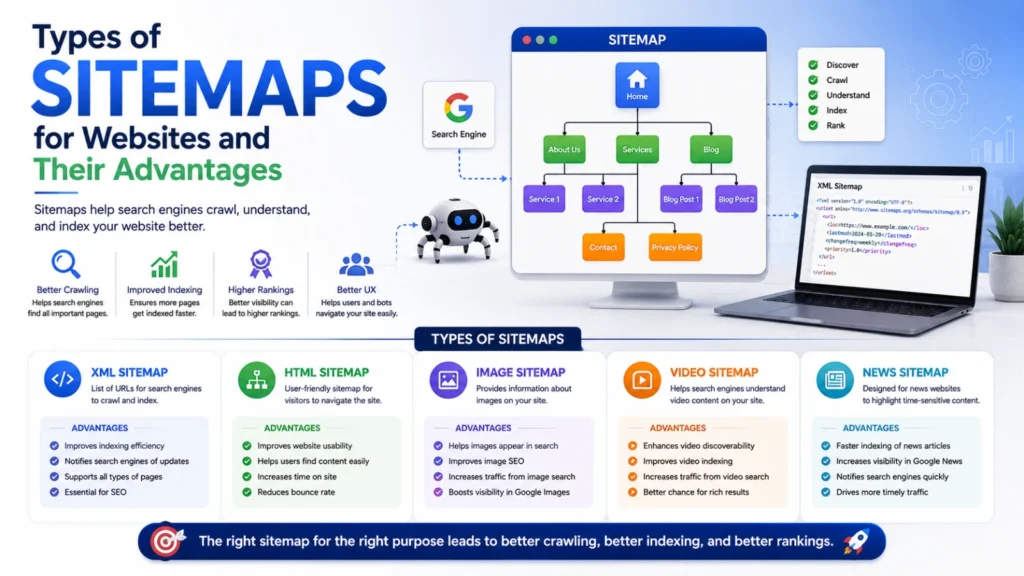
A sitemap helps search engines discover and understand your website’s content. It improves crawling efficiency and supports better search visibility.
Large and growing websites especially benefit from a well-structured sitemap. It helps search engines find new and updated pages quickly.
What Is a Sitemap?
A sitemap is a file listing the important pages on your website. It tells search engines which URLs deserve attention.
Sitemaps also provide useful information about each page. This includes update dates, images, videos, and language versions.
There are two main sitemap categories. These are XML sitemaps and HTML sitemaps.
XML Sitemap
An XML sitemap is created primarily for search engines. Visitors usually never see this file. It lists important website URLs in a structured XML format. Search engines use it to discover content efficiently.
Advantages of XML Sitemaps
- Improves website crawlability.
- Helps search engines discover new pages.
- Speeds up indexing of updated content.
- Supports large websites with thousands of pages.
- Helps identify orphan pages.
- Improves technical SEO.
Example:
HTML Sitemap
An HTML sitemap is designed for website visitors. It provides a clickable list of important pages.
Users can quickly navigate the website using this page. It also improves accessibility.
Advantages of HTML Sitemaps
- Improves website navigation.
- Enhances user experience.
- Helps visitors find important pages.
- Supports internal linking.
- May reduce bounce rates.
Image Sitemap
Image sitemaps help search engines discover website images. They improve image indexing.
This sitemap is useful for photographers and eCommerce stores. It also benefits portfolio websites.
Advantages
- Improves Google Images visibility.
- Helps index hidden images.
- Supports image SEO.
- Increases image search traffic.
Video Sitemap
Video sitemaps provide information about website videos. They include titles, descriptions, and thumbnails. Search engines understand video content more effectively.
Advantages
- Improves video indexing.
- Increases video search visibility.
- Helps rich results appear.
- Drives more organic traffic.
News Sitemap
News sitemaps are created for news publishers. They help Google discover fresh articles quickly. Google News uses this sitemap for faster content discovery.
Advantages
- Faster news indexing.
- Better Google News visibility.
- Improves publishing speed.
- Supports time-sensitive content.
Sitemap Index
Large websites often have multiple sitemaps. A sitemap index organizes them into one file. Instead of submitting several files, you submit one sitemap index.
Example:
https://webdesignerindubai.com/sitemap_index.xml
Advantages
- Organizes multiple sitemaps.
- Simplifies sitemap management.
- Supports very large websites.
- Improves scalability.
Category Index
Category sitemaps contain category archive pages. They help search engines understand website structure.
Blogs and eCommerce websites commonly use them.
Advantages
- Improves category indexing.
- Strengthens topical relevance.
- Supports internal linking.
- Helps organize content.
Product Sitemap
Online stores use product sitemaps. These list all product pages. Product updates become easier for search engines to detect.
Advantages
- Faster product indexing.
- Better product visibility.
- Supports inventory updates.
- Improves eCommerce SEO
Blog Sitemap
A blog sitemap contains blog posts only. It helps search engines discover published articles. Many SEO plugins generate this automatically.
Advantages
- Faster article indexing.
- Better content discovery.
- Supports frequent publishing.
- Improves blog SEO.
Author Sitemap
Author sitemaps list author archive pages. Multi-author websites often generate them.
Advantages
- Improves author page indexing.
- Supports E-E-A-T signals.
- Organizes author profiles.
- Helps search engines understand content ownership.
Why Every Website Needs a Sitemap
A sitemap makes crawling more efficient. Search engines discover valuable pages faster. It does not guarantee rankings. However, it improves indexing opportunities. Sitemaps are especially useful for new websites. They also help large websites with complex structures. Even small websites benefit from having one. It is an important technical SEO practice.
Best Practices
- Keep your sitemap updated.
- Include only important URLs.
- Remove broken pages.
- Exclude noindex pages.
- Submit the sitemap to Google Search Console.
- Submit the sitemap to Bing Webmaster Tools.
- Use a sitemap index for large websites.
- Monitor sitemap errors regularly.
Conclusion
Sitemaps help search engines understand your website better. They also improve crawl efficiency. Different sitemap types serve different purposes. Together, they create a stronger SEO foundation. Maintaining accurate sitemaps supports better indexing. It also helps visitors and search engines navigate your website effectively.
Frequently Asked Questions
What is the purpose of a sitemap?
A sitemap helps search engines discover, crawl, and index important pages on your website.
What is the difference between XML and HTML sitemaps?
XML sitemaps help search engines. HTML sitemaps help website visitors navigate pages.
Does every website need a sitemap?
Yes. Every website benefits from improved crawling and indexing through a sitemap.
Where is a sitemap located?
Most websites use /sitemap.xml or /sitemap_index.xml.
How do I submit a sitemap?
Submit your sitemap through Google Search Console and Bing Webmaster Tools.
How often should a sitemap update?
It should update whenever important website content changes.
Can one website have multiple sitemaps?
Yes. Large websites commonly use multiple sitemaps connected through a sitemap index.
Are sitemaps important for SEO?
Yes. Sitemaps improve crawlability, indexing, and technical SEO performance.
